 how-to
How Do You Organize Kitchen Cabinets Efficiently?
Quick Summary
To organize kitchen cabinets efficiently, first empty each cabinet and sort items into keep, donate, toss, and relocate piles. Then group the keepers into zones by how often you use them, placing daily items at eye level.
- Empty one cabinet at a time and sort items into four piles: keep, donate, toss, and relocate.
- Check dates on spices, sauces, and canned goods, since expired food hidden in back wastes space.
- Group items into prep, cooking, cleaning, and serving zones near where you use them.
- Store lightweight items like glasses and cereal in upper cabinets, and heavy pots in lower cabinets.
- Measure each cabinet's interior width, depth, and clear height before buying any organizer.
Table of Contents
- Start by Emptying and Decluttering Your Kitchen Cabinets
- Group Items into Zones by How Often You Use Them
- Decide What Goes in Upper vs. Lower Cabinets
- Add Vertical Storage with Risers, Racks and Pull-Outs
- Choosing the Best Kitchen Cabinet Organizers for Your Space
- Mistakes That Undo Your Organization
- Book a Cabinet Storage Upgrade with Handy Gonzo's
- Frequently Asked Questions
Start by Emptying and Decluttering Your Kitchen Cabinets
Most kitchen cabinet problems start with too much stuff. The fastest way to organize kitchen cabinets is to take everything out first. Don't try to sort items while they're still on the shelves.
Pull out every item from one cabinet at a time. Set everything on the counter or the kitchen table. This makes it easy to see what you actually have.
Next, sort items into four piles:
- Keep: Items you use often and still like
- Donate: Good items you rarely use
- Toss: Expired food, broken tools, and chipped dishes
- Relocate: Items that belong in another room
Be honest with yourself. Most people own three or four mixing bowls they never touch. Get rid of duplicates first.
Watch out: Check the dates on spices, sauces, and canned goods. Expired food hidden in the back of a cabinet is a common reason people feel like they never have space.
Group Items into Zones by How Often You Use Them
Once your cabinets are empty, group similar items into zones. Zoning means keeping related things together and near where you use them. This saves steps and time while cooking.
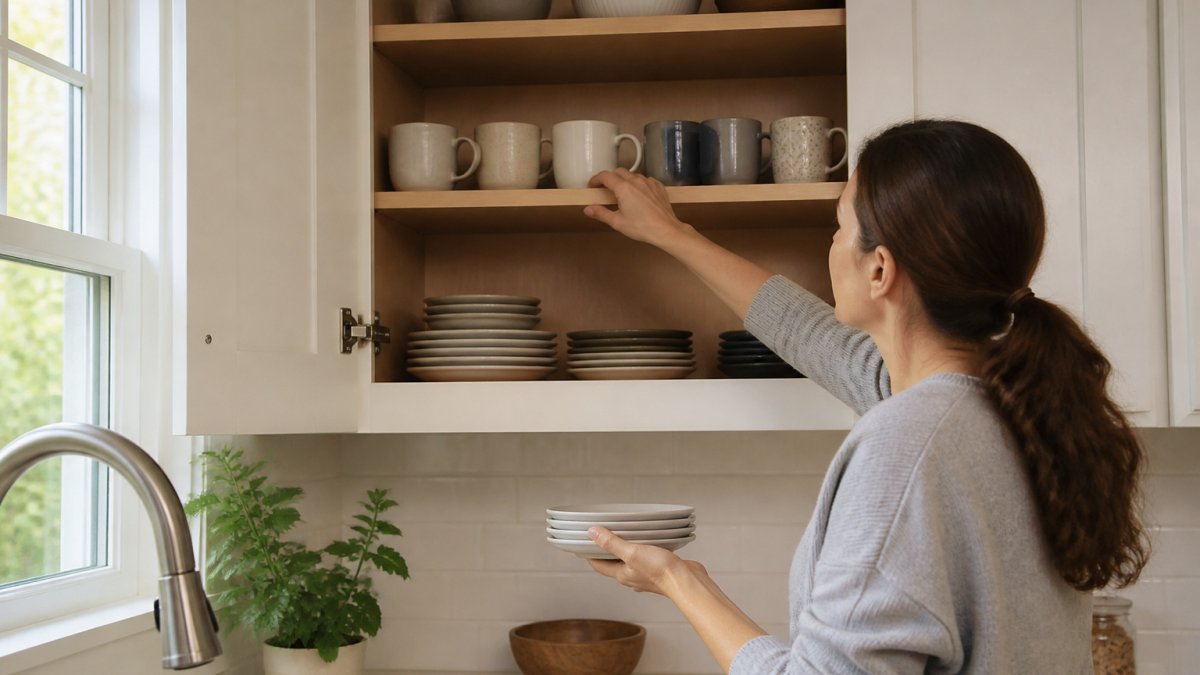
Most kitchens work well with these zones:
- Prep zone: Cutting boards, knives, mixing bowls, and measuring cups near the counter
- Cooking zone: Pots, pans, oils, and spices near the stove
- Cleaning zone: Dish soap, sponges, and towels under the sink
- Serving zone: Plates, glasses, and utensils near the dining area
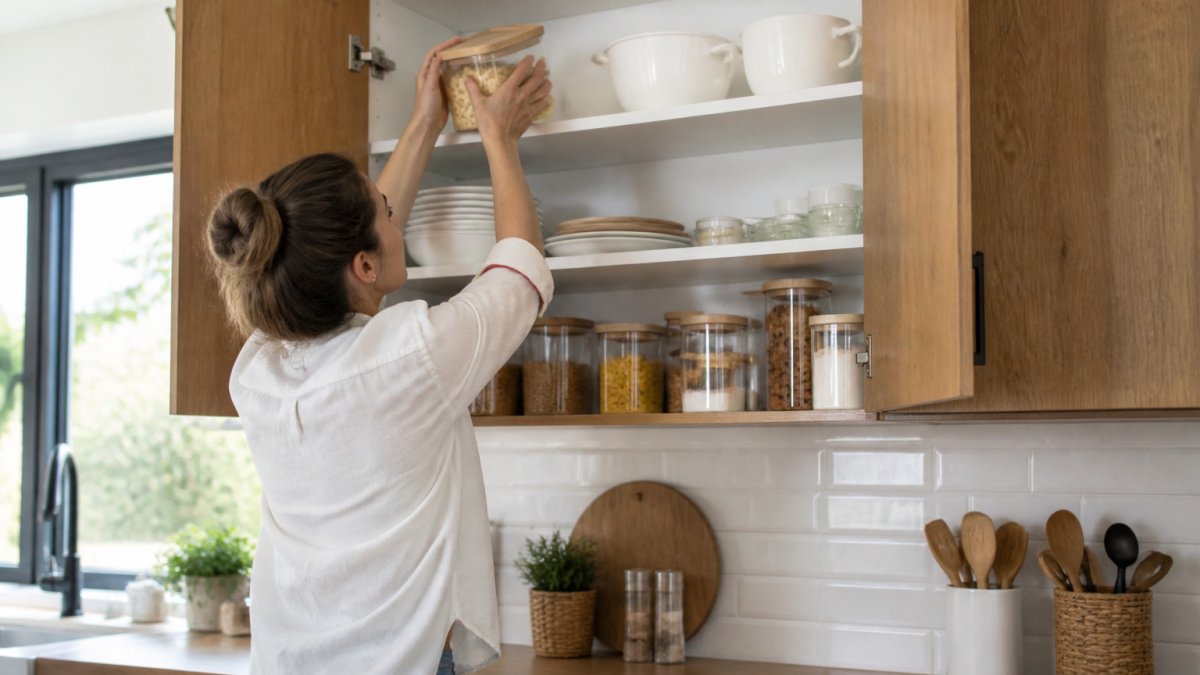
Put the things you use every day at eye level. Store rarely used items on the highest or lowest shelves. Holiday platters and extra appliances work well there.
Keep the zone closest to your main work area as your priority. For most people, that is the cooking zone.
Decide What Goes in Upper vs. Lower Cabinets
Upper cabinets are best for light, everyday items. Lower cabinets can hold heavier things you reach for often.
A simple rule helps here:
- Upper cabinets: Glasses, mugs, cereal, spices, and lightweight dishes
- Lower cabinets: Pots, pans, small appliances, and heavy containers
- Drawers: Utensils, cutlery, and small tools
Heavy cookware in an upper cabinet is hard to lift and can be unsafe. Keep your heaviest pans in the lower cabinet closest to the stove.
Add Vertical Storage with Risers, Racks and Pull-Outs
Most cabinets waste space above and below each shelf. Vertical storage fixes that. It turns one shelf into two or three usable levels.
Shelf Risers and Adjustable Shelving
Shelf risers are simple stepped platforms that lift items up so you can see what's behind them. They work well for plates, cans, and jars.
Adjustable shelving lets you change the height of each shelf. Move the shelves to fit tall bottles or short containers. Many cabinets have shelf pin holes already, so you can add shelves without tools.
Door-Mounted Racks and Corner Solutions
The inside of a cabinet door is often unused. Slim racks attached to the door hold cutting boards, baking sheets, lids, or spice jars.
Corner cabinets are hard to use. Use a lazy Susan or a corner pull-out tray to bring items into reach. These are a big help for pots and pans.
Choosing the Best Kitchen Cabinet Organizers for Your Space
Not every organizer fits every cabinet, and the wrong one wastes money and steals usable space. If your cabinets need more than organizers, explore a full kitchen remodel with better cabinet layouts. Before you buy anything, measure each cabinet opening and write the numbers down. You need three figures per shelf: interior width, interior depth, and clear height between shelves. Measure at the front and the back, because many cabinet boxes are not perfectly square and a pull-out that fits the front may bind at the rear.
Measure First, Then Match the Organizer
Use this sequence so you do not buy twice:
- Clear height. Measure from the shelf surface to the underside of the shelf above. A standard base cabinet shelf often has about 10 to 12 inches of clear height; upper cabinet shelves are commonly 10 to 15 inches apart. Confirm your own numbers rather than assuming.
- Interior width and depth. Measure inside the cabinet box, not the door opening. A pull-out needs a few sixteenths of an inch of clearance on each side for the slides.
- Door swing and hinge type. Full-overlay hinges and corner cabinets change what a door-mounted rack can hold. Open the door through its full arc and check that a rack will not hit the shelf above or the counter below.
- Load weight. Add up what you plan to store. A stack of cast-iron skillets can weigh far more than a row of cereal boxes, and thin wire racks rated for light dishes will sag under heavy cookware.
Match the Organizer to the Job
| Organizer | Best For | Fit Check Before Buying |
|---|---|---|
| Shelf risers | Plates, cans, jars, mugs | Clear height must exceed the tallest item plus the riser step |
| Pull-out shelves | Pots, pans, small appliances | Confirm slide clearance on both sides and that the door opens past 90 degrees |
| Door-mounted racks | Lids, cutting boards, spice jars | Check hinge type and that the rack clears the shelf edge when the door closes |
| Lazy Susan | Corner base cabinets | Measure the corner opening; a full-round tray needs a square opening, a pie-cut tray fits a blind corner |
| Drawer dividers | Utensils, cutlery, small tools | Measure drawer interior and account for the drawer slide hardware |
| Adjustable shelving | Tall bottles, short containers | Confirm the cabinet has shelf-pin holes and that new shelves clear the door |
Materials and Trade-Offs
Sturdy materials matter more than a low price. Thin wire and flimsy plastic bend under heavy dishes, and a sagging pull-out can damage the cabinet floor. Look for solid wood, metal, or heavy-duty plastic rated for the weight you plan to store.
Mistakes That Undo Your Organization
Even a well-organized kitchen drifts back to clutter. The fixes below go beyond "don't buy too many bins" and address the mechanisms that actually cause relapse.
Buying Containers Before You Measure
The most common undo is buying bins, risers, and dividers before measuring the cabinet. A container that is a quarter inch too tall keeps the door from closing; one that is too deep hides items at the back. Measure the interior width, depth, and clear height of every shelf first, then buy to those numbers. Return anything that does not fit before it becomes permanent clutter.
Organizing Before You Declutter
Sorting items you do not need wastes effort and locks clutter into a tidy-looking system. Empty one cabinet at a time, make the keep, donate, toss, and relocate piles, and only then decide what organizer the remaining items need. If a cabinet ends up half empty, you may not need an organizer at all.
Grouping by Shape Instead of Use
A cabinet full of same-size containers looks neat but slows you down if the items inside are unrelated. Group by cooking task instead: baking sheets with mixing bowls, spices with oils near the stove, food-storage containers with lids and wrap. The test is whether you can grab everything for one task without opening a second cabinet.
Overloading Upper Cabinets and High Shelves
Heavy items on high shelves are a safety risk and a reason people stop using those shelves. Keep cast iron, stockpots, and bulk appliances in lower cabinets or on the lowest shelf you can reach safely. Reserve upper shelves for lightweight, occasional items.
Skipping the Reset Habit
Organization fails when items do not return to their zones. Build a short reset into your routine: after each grocery run, put new items behind older ones so nothing expires in the back; once a season, pull everything off one shelf, wipe it down, and remove anything that stopped being useful. A quarterly check is enough for most households.
Ignoring the Cabinet Itself
Sometimes the layout, not the habit, is the problem. Shelves that are too shallow, doors that hit when opened, or a blind corner that swallows items will defeat any organizer. If you have reset the same cabinet three times and it still fails, the fix is a storage upgrade, not another bin.
Book a Cabinet Storage Upgrade with Handy Gonzo's
Some cabinets need more than organizers. You can review kitchen remodeling services for Fort Worth homes to see what a full upgrade involves. Shelves may be too shallow, doors may hit when opened, or the layout may not fit how you cook. At Handy Gonzo's Home Improvements, we serve homeowners in the DFW area with kitchen and bathroom remodeling and related home improvement services.
Our family-owned business works with a dedicated, multi-trade crew from start to finish, and keeps job sites clean. Ready to get started? Contact us and get a free estimate.
Frequently Asked Questions
What is the most efficient way to organize kitchen cabinets?
Empty the cabinet, discard what you do not use, then group items by function and frequency. Everyday dishes and glasses go at eye level near where you use them, while occasional items such as serving platters go higher or lower. Adding shelf risers and pull-out organizers lets you see and reach everything without stacking. Label bins and shelves so the system stays consistent after the first weekend.
How do you organize kitchen cabinets with limited space?
Use vertical space first. Shelf risers double the usable area on a single shelf, and door-mounted racks hold cutting boards, lids and foil. Store only what you cook with regularly, and keep backups in a separate spot. Nesting containers and stackable bins reduce wasted air. Clear, uniform containers also make small cabinets look and feel less crowded.
What are the best kitchen cabinet organizers?
The best choice depends on the cabinet. Pull-out drawers suit deep base cabinets, adjustable shelf risers suit wide upper cabinets, and revolving corner trays make hard-to-reach corners usable. Measure the interior width, depth and height before buying, since many organizers only fit specific cabinet sizes. Choose sturdy materials such as steel or solid wood for heavy cookware.
How do I declutter my kitchen cabinets effectively?
Take everything out and wipe each shelf before returning items. Sort into keep, donate and discard piles, and be honest about duplicate gadgets and expired pantry goods. Keep one working set of each everyday tool and dish. Return only what you use, and place it where you first reach for it while cooking.