 how-to
How to Hire a Contractor for Kitchen Renovation
Table of Contents
- What a Contractor for Kitchen Renovation Actually Does
- How to Find and Vet a Kitchen Renovation Contractor
- Questions to Ask Kitchen Contractors Before Signing Anything
- Red Flags When Hiring a Contractor
- Kitchen Renovation Timeline: Phase by Phase
- Hidden Costs and How to Budget Without Surprises
- Sustainable and Eco-Friendly Kitchen Renovation Options
- Conclusion
Last Updated: August 24, 2026
What a Contractor for Kitchen Renovation Actually Does
Hiring the right contractor for kitchen renovation is one of the most consequential decisions a homeowner makes. The kitchen is the most complex room in any house: plumbing, electrical, cabinetry, structural framing, tile, and finish work all converge in one space. A qualified general contractor manages that complexity so you don't have to.
A general contractor for kitchen renovation is the single point of accountability for your entire project. They coordinate subcontractors, pull building permits, manage the project timeline, source materials, and ensure every trade finishes in the correct sequence. Without that coordination, you end up with a plumber who can't work because the electrician hasn't roughed in yet, or cabinets delivered before the flooring is level.
A full-service kitchen contractor handles design consultation, structural changes, fixture replacement, countertop installation, custom cabinetry, backsplash and tile installation, plumbing upgrades, and electrical wiring for new appliances or lighting. That's a different animal from hiring a handyman for a single task.
Full-Service Remodel vs. Specialty Trades
The core question is whether you need a design-build general contractor or a specialty trade. Specialty contractors, plumbers, electricians, tile setters, are licensed for one discipline and are the right call for targeted upgrades like swapping a faucet or retiling a backsplash. But the moment your project involves multiple trades, a floor plan change, or structural changes, a general contractor becomes essential. They manage sequencing, carry the master liability, and are accountable when something goes wrong.
A design-build contractor combines architectural design with construction management, reducing miscommunication between designer and builder, often compressing the timeline, and giving you a single contract covering both phases.
How to Find and Vet a Kitchen Renovation Contractor
Most homeowners start with a search or referral. Both are valid starting points, but neither substitutes for actual vetting. Build a short list of three to five candidates who are licensed, insured, and have a verifiable track record on similar projects.

Start by checking the Contractors State License Board resources and your state's licensing authority. Most states require general contractors to hold an active license and carry both general liability insurance and workers' compensation coverage. Verifying this takes five minutes and eliminates significant risk.
Ask for references from projects completed within the last 12 to 18 months. When you call those references, ask specific questions: Did the project finish on schedule? Were there unexpected costs? How was the job site maintained during construction?
Verifying License, Insurance, and References
License verification is non-negotiable. According to the Federal Trade Commission's guidance on hiring home improvement contractors, homeowners should always verify contractor licenses through their state licensing board before signing any agreement. An unlicensed contractor cannot legally pull building permits, which means any work may not pass inspection and becomes your problem when you sell the home.
Insurance verification is equally critical. Request a certificate of insurance directly from the contractor's insurer, not a copy the contractor provides. Confirm both general liability and workers' compensation are active. If a worker is injured on your property and the contractor lacks workers' comp, you may be liable.
Call at least two references. Ask whether the contractor's crew was consistent throughout the project; a rotating cast of unfamiliar faces is a red flag.
Contractor Vetting Checklist
Use this checklist before signing any contract:
- Verified active state contractor's license through the official licensing board
- Confirmed general liability insurance with adequate coverage limits
- Confirmed active workers' compensation coverage
- Received and reviewed a written, itemized estimate
- Called at least two references from projects completed within 18 months
- Confirmed the contractor will pull all required building permits
- Reviewed the contract for payment schedule, change order process, and workmanship warranty terms
- Confirmed who the dedicated crew members are and whether they change mid-project
- Verified the contractor has experience with projects of similar scope and budget
Questions to Ask Kitchen Contractors Before Signing Anything
Questions to ask kitchen contractors are the most underused tool in the hiring process. Here are the questions that separate capable contractors from problematic ones.
Who pulls the permits, and who is responsible if inspections fail? A qualified contractor pulls their own permits and handles all communication with the local building department. If a contractor suggests you pull permits yourself, walk away.
Who are the subcontractors, and how long have you worked with them? Long-term relationships with the same plumber, electrician, and tile installer indicate a stable operation. Contractors who assemble a new crew for every job introduce unnecessary variability.
What does your change order process look like? Scope changes happen. The question is whether they're documented in writing before work proceeds.
What is your communication cadence during the project? You should know, before signing, how often you'll receive updates and through what channel.
What does your workmanship warranty cover, and for how long? A reputable contractor stands behind their work. Get warranty terms in writing.
What's your payment schedule? A standard structure ties payments to project milestones, not arbitrary dates. Be cautious of any contractor who asks for more than a third of the total cost upfront.
| Question | What a Good Answer Looks Like | Red Flag Answer |
|---|---|---|
| Who pulls permits? | "We handle all permits" | "You can do it yourself" |
| Change order process | Written approval before work proceeds | Verbal agreements only |
| Subcontractor relationships | Long-term, named partners | "We find people as needed" |
| Payment schedule | Milestone-based installments | Large upfront payment required |
| Workmanship warranty | Written, 1+ year coverage | Vague or verbal only |
| Communication frequency | Defined schedule, written updates | "We'll call when there's news" |
Red Flags When Hiring a Contractor
Red flags when hiring a contractor are worth knowing before you're sitting across a table from one. The pressure of a renovation timeline can make warning signs easy to rationalize. Don't.
Unusually low bids. If one estimate is dramatically lower than the others, something is missing, either from the scope, the materials, or the insurance coverage. Low bids frequently become expensive projects once change orders accumulate.
No written contract. Any contractor who resists putting the full scope, timeline, materials, and payment schedule in writing is not a contractor you want managing your kitchen.
Pressure to decide immediately. Legitimate contractors have full schedules and don't need to manufacture urgency to close a deal.
Asking you to pull permits. This shifts legal liability onto you and often signals the contractor isn't properly licensed.
No physical address or verifiable business history. A contractor operating without a traceable business address is difficult to hold accountable if things go wrong.
Requesting cash payments. Cash-only arrangements eliminate your paper trail and often signal unlicensed work.
Kitchen Renovation Timeline: Phase by Phase
A kitchen renovation timeline runs longer than most homeowners expect. A standard full-service kitchen remodel typically spans six to twelve weeks from demolition to final walkthrough, depending on scope, permit approval times, and material lead times.
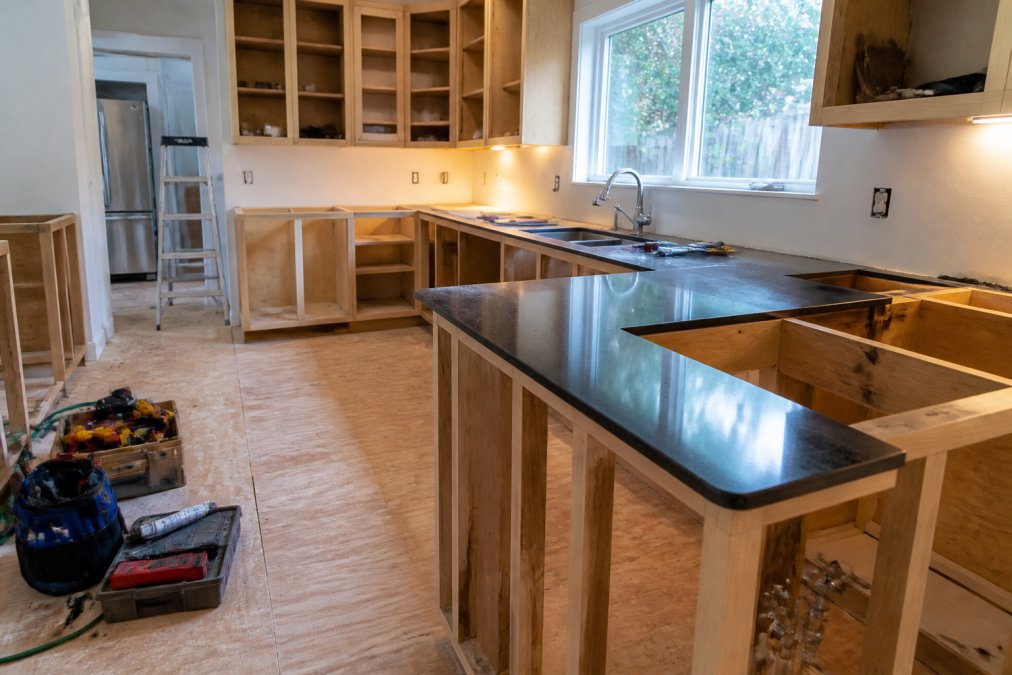
Here's how a well-managed project phases out:
- Design and planning (2-4 weeks): Floor plan finalization, material sourcing, cabinetry hardware selection, appliance orders. Custom cabinetry can have lead times of four to eight weeks.
- Permitting (1-3 weeks): Permit approval timelines vary by municipality. Your contractor submits the application; the local building department reviews and approves.
- Demolition (2-5 days): Existing cabinets, countertops, flooring, and sometimes walls come out.
- Rough-in work (1-2 weeks): Plumbing upgrades, electrical wiring, and structural changes happen here.
- Inspections: Required after rough-in and before walls close.
- Cabinetry and countertop installation (1-2 weeks): Custom cabinetry is installed first; countertops follow once cabinets are level and secured.
- Tile installation and backsplash (3-5 days): Tile work requires cure time before grouting.
- Finish work and fixture replacement (1 week): Appliances, lighting, hardware, and final trim.
- Final inspection and punch list (2-5 days): The building department signs off; the contractor addresses remaining items.
Permits, Inspections, and Structural Changes
Permits are not optional. According to the U.S. Department of Housing and Urban Development's homeowner resources, unpermitted work can complicate home sales, void homeowner's insurance claims, and require costly demolition to bring a property into compliance. Any kitchen renovation involving electrical wiring, plumbing upgrades, or structural changes to walls requires permits in virtually every jurisdiction.
Structural changes, removing a wall to open a floor plan, adding a kitchen island that requires new plumbing, relocating the sink, trigger the most rigorous inspection requirements. Load-bearing walls require engineering review. Your contractor should know this before submitting the permit application.
Hidden Costs and How to Budget Without Surprises
The biggest complaint homeowners have after a kitchen renovation is the gap between the initial estimate and the final invoice. Hidden costs are real, but most are predictable if you know where to look.
Structural surprises behind walls. Old plumbing, outdated electrical panels, water damage, or non-standard framing are common in homes over 20 years old. A contractor can't price what they can't see, but they should flag these as contingency risks before you sign.
Material price changes. Custom cabinetry, countertop slabs, and specialty tile are often quoted at current prices. Get written confirmation of how long quotes are valid.
Permit fees. These vary by municipality and project scope and are often paid directly to the building department.
Temporary kitchen setup. If you'll be without a functional kitchen for six to eight weeks, factor in the cost of eating out or setting up temporary cooking space.
Appliance installation fees. Many appliance retailers charge separately for delivery and installation. Confirm whether your contractor's scope includes appliance hookup.
A well-structured renovation budget allocates 10 to 15 percent of the total project cost as a contingency reserve.
Sustainable and Eco-Friendly Kitchen Renovation Options
Sustainable kitchen renovation is increasingly practical, affecting both operating costs and resale value. Many eco-friendly choices are also durable choices, paying for themselves over time.
Cabinetry. Look for cabinets made from sustainably harvested wood certified by the Forest Stewardship Council, or opt for formaldehyde-free plywood and MDF.
Countertops. Recycled glass, reclaimed wood, and paper composite surfaces are increasingly available and competitive in durability.
Appliances. ENERGY STAR-certified appliances consume significantly less energy than standard models. The ENERGY STAR program maintained by the U.S. Environmental Protection Agency provides verified ratings across refrigerators, dishwashers, and range hoods.
Lighting. LED fixtures use a fraction of the energy of incandescent alternatives and last significantly longer.
Low-VOC finishes. Paints, sealers, and adhesives emit volatile organic compounds during and after application. Low-VOC and zero-VOC products reduce off-gassing that affects air quality.
Water-efficient fixtures. WaterSense-labeled faucets use at least 20 percent less water than standard models without sacrificing performance.
Prioritize the highest-impact categories, appliances, cabinetry, and lighting, and make standard choices elsewhere if the renovation budget requires it.
Finding a qualified contractor for kitchen renovation takes more than a web search. The homeowners who end up satisfied are the ones who verify credentials, ask hard questions before signing, and treat the contractor vetting process as seriously as the design decisions.
Handy Gonzo's Home Improvements brings over 35 years of construction knowledge to every kitchen remodel, with a dedicated multi-trade crew that stays consistent from demolition through final walkthrough. Our digital quoting process gives you a clear breakdown of materials, labor, and timeline before a single cabinet comes off the wall, so there are no surprises halfway through. Get a Free Estimate from Handy Gonzo's Home Improvements and see what a transparent, full-service kitchen renovation actually looks like.
Frequently Asked Questions
Should I hire a general contractor for a kitchen remodel?
For most kitchen remodels, yes. A general contractor manages subcontractors, pulls building permits, coordinates plumbing and electrical wiring, and keeps the project on schedule. If your renovation involves structural changes, cabinetry installation, or multiple trades working at once, a licensed general contractor reduces the risk of costly errors and scheduling conflicts. Smaller cosmetic updates like backsplash tile or fixture replacement can sometimes be handled by individual tradespeople, but a full-service remodel almost always benefits from single-point project management.
What questions should I ask a kitchen contractor before hiring?
Ask whether they are licensed and insured in your state, who pulls the building permits, and whether they use a dedicated crew or rotating subcontractors. Request a written contract that itemizes materials, labor, and the project timeline. Ask how they handle change orders and what their workmanship warranty covers. Also confirm how often they communicate progress updates. These questions to ask kitchen contractors will reveal how organized and transparent a company is before any money changes hands.
What is a realistic kitchen renovation timeline?
A standard kitchen renovation timeline runs four to twelve weeks from demolition to final walkthrough, depending on the scope. Design and material sourcing can add two to four weeks before work begins. Permit approval timelines vary by municipality. Custom cabinetry typically requires four to six weeks of lead time. Kitchens involving structural changes, new electrical wiring, or plumbing upgrades take longer than cosmetic refreshes. Get a written schedule from your contractor with milestone dates so you can track progress and hold the team accountable.
How do I verify a contractor's license and insurance?
Most states maintain an online contractor license lookup tool through the state licensing board or department of consumer affairs. Search by name or license number to confirm the license is active and in good standing. For insurance, ask the contractor to provide a certificate of insurance naming you as an additional insured for the project duration. Verify the policy covers general liability and workers' compensation. Never rely solely on a contractor's verbal assurance, always request documentation before signing a contract.
This article was written using GrandRanker
Frequently Asked Questions
Should I hire a general contractor for a kitchen remodel?
For most kitchen remodels, yes. A general contractor manages subcontractors, pulls building permits, coordinates plumbing and electrical wiring, and keeps the project on schedule. If your renovation involves structural changes, cabinetry installation, or multiple trades working at once, a licensed general contractor reduces the risk of costly errors and scheduling conflicts. Smaller cosmetic updates like backsplash tile or fixture replacement can sometimes be handled by individual tradespeople, but a full-service remodel almost always benefits from single-point project management.
What questions should I ask a kitchen contractor before hiring?
Ask whether they are licensed and insured in your state, who pulls the building permits, and whether they use a dedicated crew or rotating subcontractors. Request a written contract that itemizes materials, labor, and the project timeline. Ask how they handle change orders and what their workmanship warranty covers. Also confirm how often they communicate progress updates. These questions to ask kitchen contractors will reveal how organized and transparent a company is before any money changes hands.
What is a realistic kitchen renovation timeline?
A standard kitchen renovation timeline runs four to twelve weeks from demolition to final walkthrough, depending on the scope. Design and material sourcing can add two to four weeks before work begins. Permit approval timelines vary by municipality. Custom cabinetry typically requires four to six weeks of lead time. Kitchens involving structural changes, new electrical wiring, or plumbing upgrades take longer than cosmetic refreshes. Get a written schedule from your contractor with milestone dates so you can track progress and hold the team accountable.
How do I verify a contractor's license and insurance?
Most states maintain an online contractor license lookup tool through the state licensing board or department of consumer affairs. Search by name or license number to confirm the license is active and in good standing. For insurance, ask the contractor to provide a certificate of insurance naming you as an additional insured for the project duration. Verify the policy covers general liability and workers' compensation. Never rely solely on a contractor's verbal assurance — always request documentation before signing a contract.