 how-to
Energy Efficient Home Building Standards in Texas
Table of Contents
- Texas Energy Code Requirements for New Homes
- Energy-Efficient Home Design in Texas: Climate Zone Rules That Decide Your Build
- A Practical Build-to-Compliance Checklist for Texas Homes
- Texas Home Energy Inspections: What Reviewers Actually Check
- ENERGY STAR Certified Homes in Texas: Beyond-Code Performance
- What Meeting or Exceeding Energy Standards Costs Texas Homeowners
- Common Mistakes That Fail Texas Energy Code Compliance
- Conclusion: Building to Standard Without the Guesswork
- Frequently Asked Questions
Last Updated: October 13, 2026
Texas Energy Code Requirements for New Homes
Texas does not enforce a single statewide energy code for private homes.
Here is what that means in practice. The state adopts a base code edition, local building departments amend it, and your build must satisfy whatever version your permit office is running.
At Handy Gonzo's Home Improvements, we have worked across the DFW Metroplex for over three and a half decades.
Which Code Edition Applies and When
The edition that applies is the one your local building department has adopted as of your permit date. Not the year you bought the land. Not the year you drew the plans.
Energy provisions for homes come from two related documents:
- The International Energy Conservation Code (IECC), which covers the building envelope, windows, air sealing, and mechanical systems
- The International Residential Code (IRC), whose Chapter 11 carries energy provisions for one- and two-family dwellings
Texas updates its base adoption periodically, and cities then choose whether to adopt that edition, an older one, or a stricter local version. Some jurisdictions add local amendments on top.
Always confirm the current edition with your local building department before you finalize plans. For the model codes themselves, see the International Code Council code adoption resources.
Energy-Efficient Home Design in Texas: Climate Zone Rules That Decide Your Build
Climate zone drives almost every number in the energy code. The IECC divides the country into zones by county, and each zone carries its own minimum R-values, window ratings, and envelope requirements.
Most of the DFW Metroplex falls in IECC Climate Zone 3, with portions of the western and panhandle regions in Zones 4 and 5, and the Gulf Coast in Zone 2.
How Climate Zones Map Across the State
| Region | Typical IECC Zone | Dominant Load |
|---|---|---|
| Gulf Coast and South Texas | 2 | Cooling |
| DFW Metroplex, Central Texas, East Texas | 3 | Cooling |
| West Texas, Hill Country edges | 4 | Mixed |
| Panhandle and High Plains | 4 to 5 | Heating and cooling |
Your exact zone is set by county, not by feel. Confirm it with your local building department or the IECC climate zone map before you finalize envelope specs.
Insulation, Windows, and Air Sealing by Zone
Insulation is measured by R-value, a material's resistance to heat flow. Higher R-value means better resistance.
Windows and doors use two ratings:
- U-factor, which measures how fast heat moves through the assembly. Lower is better.
- Solar heat gain coefficient (SHGC), which measures how much solar heat passes through. In hot climates, a lower SHGC keeps cooling loads down.
In Zone 2 and Zone 3, code typically caps U-factor around 0.35 to 0.40 and SHGC around 0.25 to 0.35 for fenestration.
Air sealing is the cheapest efficiency upgrade you can make. A well-sealed envelope stops conditioned air from leaking out and outdoor humidity from leaking in.
| Building Element | What the Code Sets | Why It Matters in a Hot Climate |
|---|---|---|
| Ceiling insulation | Minimum R-value by zone | Reduces heat gain from attic |
| Wall insulation | Minimum R-value by zone | Cuts afternoon heat transfer |
| Windows | Maximum U-factor and SHGC | Lowers cooling demand |
| Air sealing | Leakage limits | Stops humidity and air loss |
| Duct insulation | Minimum R-value | Keeps cooled air cold |
Why Zone Matters More Than Any Single Product
Two builders can install identical windows and still land on different compliance outcomes if their zones differ. The zone sets the target; the product meets it. That is why the first design decision is not which window to buy, it is which zone your lot sits in and which code edition your permit office enforces.
For a plain-language look at how the U.S. Department of Energy frames these requirements, see DOE building energy codes program.
A Practical Build-to-Compliance Checklist for Texas Homes
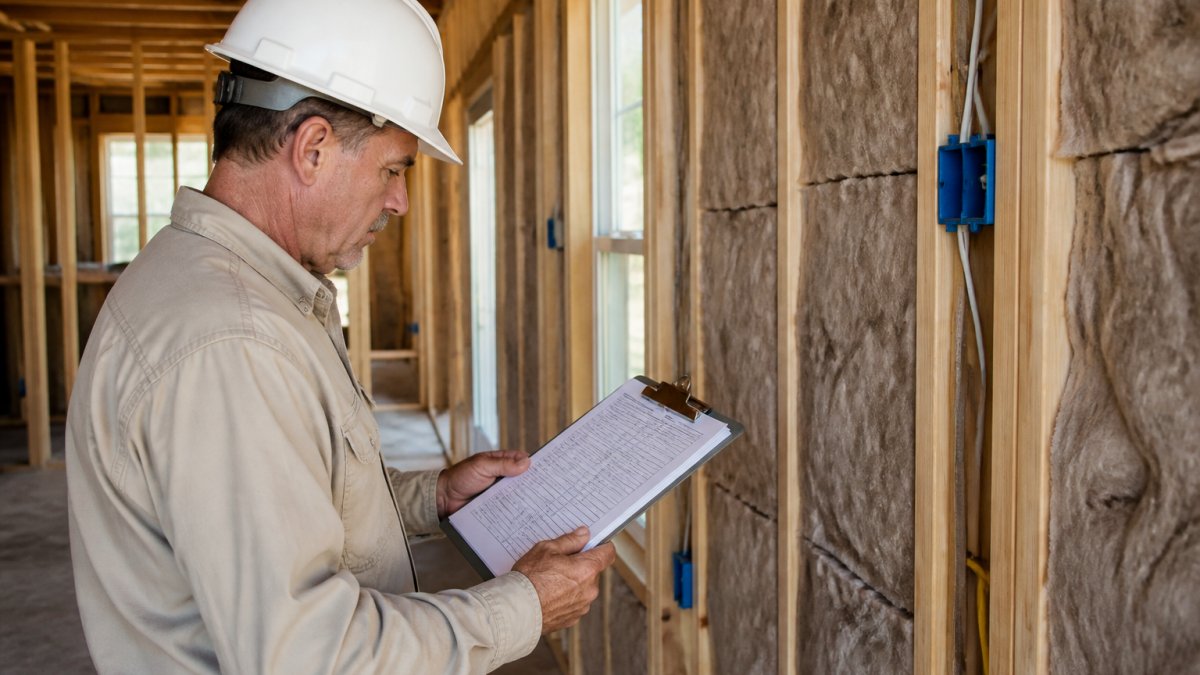
A compliance checklist is the fastest way to avoid a failed inspection. Work it in order, and confirm every line with your local building department before you close up walls.
- Confirm the adopted code edition with your permit office
- Check for local amendments beyond the base code
- Verify insulation R-values for your specific climate zone
- Select windows meeting the U-factor and SHGC limits
- Plan the air sealing details before drywall
- Confirm duct insulation and duct leakage limits
- Check HVAC equipment efficiency ratings
- Schedule the rough-in inspection before covering walls
- Keep product spec sheets for the final inspection
Most of these steps cost nothing extra if you plan them early. The expensive failures come from discovering a requirement after the walls are closed.
Texas Home Energy Inspections: What Reviewers Actually Check
Inspectors verify what they can see and measure. Plan review happens first, then field inspections at set stages. If you skip a stage, you may have to open finished work.
Reviewers typically check:
- Insulation installed to the specified R-value and depth
- Air sealing at penetrations, plates, and gaps
- Window and door ratings matching the approved plans
- Duct sealing and insulation
- HVAC equipment efficiency ratings
- Compliance documentation for installed products
Energy performance is sometimes verified through a HERS Index, a home energy rating that scores a home's efficiency against a reference home. Lower scores mean better performance. Not every jurisdiction requires a rating, so ask before you budget for one.
ENERGY STAR Certified Homes in Texas: Beyond-Code Performance
ENERGY STAR certified homes in Texas meet a set of requirements stricter than the base code. The program is voluntary, and it verifies performance through third-party inspection rather than a checklist alone.
A certified home generally includes:
- A tighter building envelope than code minimums
- Higher-efficiency windows and HVAC equipment
- Verified duct sealing and insulation
- A certified home energy rating to confirm performance
The trade-off is real. You pay more upfront for better windows, tighter sealing, and verified equipment. In return, you get lower cooling bills in a climate that punishes weak envelopes, plus a documented efficiency record if you sell.
For program requirements, see ENERGY STAR certified homes program.
What Meeting or Exceeding Energy Standards Costs Texas Homeowners
Meeting code costs less than most people expect. Exceeding it costs more, and the payback depends on how long you stay and how the home is used. The honest answer is that the premium is real but smaller than the marketing on either side suggests.
Here is where the money actually goes:
- Code minimum: insulation to the zone minimum, standard windows meeting U-factor and SHGC caps, basic air sealing. This is the baseline cost of any permitted new home, it is not an upgrade line item.
- Above code: better windows, tighter envelope detailing, higher-efficiency HVAC, upgraded duct sealing. A common pattern is a modest premium over code-minimum construction, concentrated in windows and HVAC.
- Certified performance: third-party verification, top-tier equipment, blower-door and duct-leakage testing. Highest upfront cost, and the only tier where you get a documented performance record.
Where the Premium Concentrates
Windows are usually the largest single above-code cost, because U-factor and SHGC improvements require better glazing assemblies, not just better frames. HVAC is second, because higher SEER2 and HSPF2 ratings carry equipment premiums.
That ordering matters. If a budget only stretches to one above-code move, tighter air sealing and duct sealing typically return more comfort per dollar than upgrading windows alone.
How Payback Actually Works
The payback comes from three places, and only one shows up in a simple energy-bill calculation:
- Cooling and heating bills. A tighter envelope and better equipment reduce runtime. In a cooling-dominated zone, the savings land hardest in summer.
- Equipment lifespan. An HVAC system that runs less lasts longer. Replacing a system years later is a real cost avoided, even though it never appears on an energy bill.
- Comfort and humidity control. In humid zones, a tight envelope and correct equipment sizing reduce indoor humidity, which is a livability gain that does not have a clean dollar figure.
A common pattern is that above-code envelope and HVAC measures pay back over a multi-year horizon, not in the first year. The longer you own the home, the better the math. If you plan to sell within a few years, the case rests more on resale documentation and comfort than on bill savings.
What to Ask Your Builder
Pricing depends on square footage, scope, and the systems you choose. Ask your builder for a line-item breakdown that separates code-minimum scope from above-code scope, so you can see exactly what each upgrade costs and decide which ones earn their place.
For program requirements and performance tiers, see ENERGY STAR certified homes program.
Common Mistakes That Fail Texas Energy Code Compliance
Most failures trace back to planning, not installation. Here are the ones we see repeatedly.
- Building to the wrong code edition. The most common and most preventable failure.
- Skipping air sealing details. Insulation cannot fix a leaky envelope.
- Wrong window ratings. A great U-factor with a high SHGC still overheats a Texas home.
- Covering work before inspection. You pay to open it back up.
- No documentation. Inspectors need spec sheets, not verbal assurances.
Conclusion: Building to Standard Without the Guesswork
Code compliance in Texas rewards planning and punishes assumptions. Confirm your edition, design for your climate zone, and document everything before walls close.
If you would rather not manage that alone, Handy Gonzo's Home Improvements can help. We bring over 35 years of construction experience, transparent digital quoting with a clear breakdown of materials, labor, and timeline, and a dedicated multi-trade crew that stays on your project from start to finish.
Get a free estimate from Handy Gonzo's Home Improvements and build to standard without the guesswork.
Frequently Asked Questions
What energy code applies to new homes in Texas?
Texas adopts energy requirements through the International Residential Code and the International Energy Conservation Code, which the state updates on its own schedule. Local jurisdictions then enforce the adopted edition, and many add amendments of their own. Because adoption dates and amendments vary by city and county, the edition that applies to your build depends on where the permit is issued. Always confirm the current edition with your local building department before finalizing plans, since designing to an outdated edition can trigger costly revisions during plan review.
Do energy-efficiency requirements vary by Texas city or county?
Yes. Texas sets a statewide floor, but local building departments can adopt newer editions or add amendments that go further. A home permitted in one city may face stricter insulation, fenestration, or duct leakage rules than the same plan permitted a county over. This is why a build-to-compliance checklist should be built around your specific jurisdiction, not a generic statewide summary. Ask your building department for the adopted edition, the effective date, and any local amendments before you submit plans.
What is the difference between an energy code and an energy-efficient home certification?
An energy code is the legal minimum a home must meet to pass inspection, covering insulation R-values, air sealing, windows, and mechanical systems. A certification like ENERGY STAR goes further, requiring third-party verification and a HERS Index score that demonstrates performance above code. Code compliance keeps you legal; certification proves the home performs better than the minimum. For Texas homeowners, certification can mean lower cooling bills in summer, but it also adds verification steps and cost during construction.
How can I check whether a new home meets energy-efficiency requirements?
Start with the certificate of compliance and inspection records from your builder, which should document insulation R-values, window U-factor and solar heat gain coefficient, and duct leakage test results. If the home is ENERGY STAR certified, ask for the HERS Index report. You can also request the plan review approval from the local building department. For existing homes, a licensed energy rater can perform an assessment.