 how-to
Is $10,000 Enough to Renovate a Kitchen?
Table of Contents
- Is $10,000 Realistic for a Kitchen Remodel?
- Breakdown of Kitchen Renovation Costs
- Cosmetic Updates vs. Full Gut Renovation
- Kitchen Cabinet Refacing vs. Replacement
- Prioritizing High-Impact Upgrades
- Hiring a Contractor for Kitchen Renovation
- Kitchen Renovation Timeline and Planning
- DIY vs. Professional Installation Costs
- Frequently Asked Questions
Last Updated: September 21, 2026
Is $10,000 Realistic for a Kitchen Remodel?
Yes, $10,000 is realistic for a kitchen renovation, but the question "Is $10,000 enough to renovate a kitchen?" depends on understanding what you're buying and what you're not. Success depends on your goals, your kitchen's current condition, and whether you're renovating for personal enjoyment or resale value.
The Financial Reality
According to the National Kitchen & Bath Association, the median kitchen remodel costs $68,596 nationally. A $10,000 project is roughly 15% of that median, enough for meaningful updates but far short of a full gut renovation. This constraint forces trade-offs that define your project's success.
Here's what $10,000 actually buys you:
- A meaningful cosmetic and functional update if your kitchen's bones are sound (plumbing and electrical work, cabinets structurally intact, no water damage or code violations)
- Cabinet refacing plus new countertops and backsplash, which are the three highest-impact visible upgrades
- Updated lighting, hardware, and paint that transform how the space feels
- NOT a full gut renovation, new appliances across the board, or structural changes
ROI Expectations: Personal Enjoyment vs. Resale Value
This is where most articles fall short. A $10,000 kitchen renovation will not recover its full cost at resale. According to Remodeling Magazine's Cost vs. Value Report, homeowners typically recover 50-60% of kitchen renovation costs in resale value, and that percentage is lower for smaller budgets. On a $10,000 project, expect to recover $5,000-$6,000 in home equity if you sell within 5 years.
Renovate primarily for your own enjoyment, not as a financial play. If you're staying 5+ years, the quality-of-life improvement justifies the cost. If you're flipping or selling within 2 years, the ROI may not pencil out.
When $10,000 Works Best
$10,000 is most realistic when:
- Your kitchen layout is already functional and you're not moving plumbing or electrical
- Your cabinets are structurally sound and don't need replacement (refacing is an option)
- You're willing to prioritize visible, high-impact upgrades over new appliances
- You can handle some of the demolition and prep work yourself to reduce labor costs
- You're staying in the home long enough to enjoy the improvements
When $10,000 Falls Short
$10,000 is unrealistic if:
- Your kitchen requires electrical or plumbing code upgrades (these alone can consume $2,000-$4,000)
- Cabinets need full replacement rather than refacing
- You want new high-end appliances
- Hidden issues like water damage, mold, or structural problems are likely
- Your kitchen layout doesn't work and you need to move walls or reconfigure the space
Understand what's possible within your budget and make deliberate choices about where to invest. Kitchen costs break down into labor, materials, and unexpected surprises.
Breakdown of Kitchen Renovation Costs
Labor vs. Materials
Labor typically consumes 40-50% of a kitchen renovation budget, materials the other 50-60%. With a $10,000 budget, you have roughly $5,000 for materials. Budget-friendly options exist: laminate countertops cost far less than granite, refaced cabinets cost less than replacement, and paint is one of the cheapest upgrades. DIYing demolition and prep work frees up money for better materials in high-impact categories.
Hidden Costs to Plan For
Kitchen renovations almost always uncover surprises: water damage, outdated electrical, or plumbing issues. Set aside 10-15% of your budget ($1,000-$1,500) as contingency. Common hidden costs include structural issues, mold remediation, code upgrades, and permit fees (typically several hundred dollars).
Cosmetic Updates vs. Full Gut Renovation
Understanding the difference between these two approaches helps you set realistic expectations for your $10,000.
A cosmetic update refreshes the look without touching major systems: paint, hardware, backsplash, lighting, and cabinet refinishing. This works well for kitchens with solid bones and functioning plumbing/electrical. A full gut renovation costs $50,000+. For $10,000, use a hybrid approach: update visible high-impact areas (cabinets, countertops, backsplash, lighting) while leaving major systems alone.
Kitchen Cabinet Refacing vs. Replacement
Cabinets typically consume 30-40% of a kitchen renovation budget. This single category often decides whether a $10,000 project feels like a success or a letdown.
Cabinet replacement means removing old cabinets and installing new ones. This is expensive, quality cabinets run $3,000-$5,000 for a modest kitchen. Installation adds another $1,000-$2,000. On a $10,000 total budget, new cabinets alone consume most of your money, leaving little for counters, backsplash, or appliances.
Cabinet refacing costs $1,500-$3,000, roughly half the price of replacement. You install new doors, drawer fronts, and hardware while keeping existing boxes. For a $10,000 budget, refacing makes more sense than replacement, freeing up $1,500-$2,000 for countertops and backsplash.
Prioritizing High-Impact Upgrades
Not all upgrades deliver equal visual impact. Some changes make a kitchen look completely different. Others are functional but subtle. On a $10,000 budget, prioritize the changes that deliver the most noticeable results.
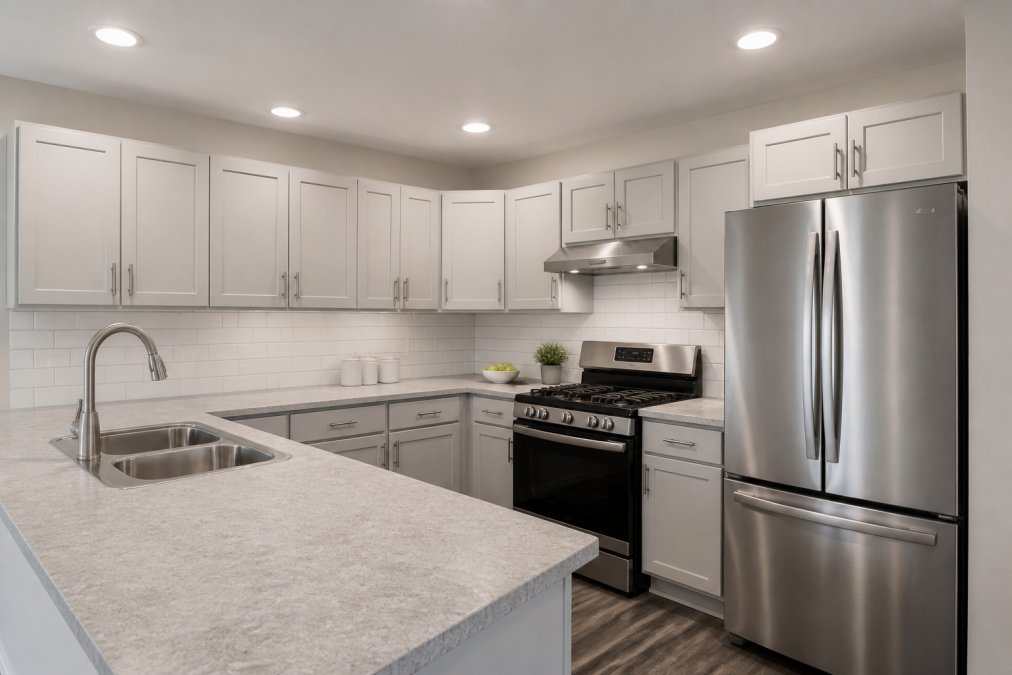
Prioritize high-impact upgrades: Countertops ($800-$2,500) transform appearance most; Backsplash ($300-$800) delivers outsized visual impact; Cabinet hardware ($200-$400) refreshes cabinets cheaply; Lighting ($400-$800) brightens the space; Paint ($300-$600) provides instant refresh. Skip new appliances unless broken, focus that money on cosmetic upgrades.
Hiring a Contractor for Kitchen Renovation
Get multiple quotes with detailed breakdowns of labor and materials. Red flags include vague descriptions, lack of timeline, and unwillingness to put estimates in writing. Ask about crew consistency, dedicated crews work more efficiently than rotating workers. Ask about job site management and daily cleanup. A professional contractor provides written timelines and manages the site so you can use your home during renovation.
Kitchen Renovation Timeline and Planning
A $10,000 kitchen renovation typically takes 3-6 weeks depending on scope. Simple cosmetic updates finish in 2-3 weeks; cabinet refacing or countertop replacement run 4-6 weeks. Material availability, payment schedules, and financing logistics are critical to keeping a tight budget on track.
Timeline depends on permits (add 1-2 weeks), material lead times (custom items 2-4 weeks; standard materials 1-2 weeks), hidden issues during demolition (1-3 weeks), and contractor availability. Plan a 1-2 week contingency buffer for delays.
Material Lead Times and Supply Chain Reality
Confirm material availability before committing.
Cash Flow and Payment Scheduling
- Deposit (25-33% of total cost): Due before work starts. On a $10,000 project, this is $2,500-$3,300. This covers initial materials and crew scheduling.
- Progress payment (33-50% of total cost): Due when major milestones are complete (demolition finished, cabinets installed, counters in place). This is $3,300-$5,000.
- Final payment (remaining balance): Due upon project completion and your approval. This is $1,700-$3,300.
Financing Options for a $10,000 Renovation
- Home equity line of credit (HELOC): If you own your home with equity, a HELOC typically offers the lowest interest rates (currently 8-12% depending on your credit and lender). You draw funds as needed, so you only pay interest on what you use. This is ideal for renovation projects because you can draw money as contractors request payments.
- Home equity loan: A fixed-rate loan against your home's equity. Rates are typically 8-11%. You receive the full $10,000 upfront, which works if you want to pay the contractor in phases without worrying about additional draws.
- Personal loan: Unsecured loans from banks or online lenders. Rates are higher (10-20%) but approval is faster and doesn't require home equity. Monthly payments are fixed, making budgeting predictable.
- Credit card with 0% promotional period: If you have strong credit, some cards offer 0% APR for 12-18 months on purchases. This works only if you can pay off the balance before the promotional period ends; interest rates jump to 18-25% after.
- Contractor financing: Some contractors partner with financing companies to offer in-house payment plans. Rates vary widely (8-18%). Ask about this option, but compare it against other financing before committing.
Discuss Timeline Expectations Upfront
- When work starts
- When major milestones occur (demolition complete, cabinets installed, counters installed, final touches)
- When the project finishes
- What happens if materials are delayed
- What happens if hidden issues surface
- Payment schedule and due dates for each phase
DIY vs. Professional Installation Costs
Some kitchen work suits DIY. Other work requires professionals. Understanding the difference saves money without creating problems.
DIY-friendly tasks:
- Painting walls and cabinets
- Installing hardware (handles and knobs)
- Removing old backsplash tile
- Demolition and removal
Professional-required tasks:
- Electrical work
- Plumbing modifications
- Gas line work
- Structural changes
- Cabinet installation
- Countertop installation
| Task | DIY Cost | Professional Cost | Recommendation |
|---|---|---|---|
| Wall painting | $200-400 | $600-1000 | DIY |
| Cabinet painting | $300-500 | $800-1200 | DIY or professional |
| Backsplash removal | $100-200 | $300-500 | DIY |
| Backsplash installation | $300-600 | $600-1000 | Professional |
| Hardware installation | $50-100 | $200-400 | DIY |
| Electrical work | Not recommended | $800-1500 | Professional only |
| Plumbing work | Not recommended | $600-1200 | Professional only |
| Countertop installation | $500-800 | $1200-2000 | Professional |
Frequently Asked Questions
What can you realistically renovate in a kitchen for $10,000?
With a $10,000 budget, you can complete a cosmetic refresh that includes cabinet refacing, new countertops, updated hardware, fresh paint, and improved lighting. A full gut renovation with new plumbing, electrical work, and layout changes typically exceeds this budget. Focus on high-visibility updates that transform appearance without structural work. Prioritize cabinets and countertops, which have the largest visual impact and typically consume 40-50% of your budget.
Is it possible to replace kitchen cabinets on a $10,000 budget?
Full cabinet replacement is challenging at $10,000 for an average kitchen. New cabinetry typically costs $3,000-$8,000 alone, leaving minimal budget for other work. Cabinet refacing is a better option, costing $1,500-$3,500 while preserving existing frames. Alternatively, refresh existing cabinets with new hardware and paint. If replacement is essential, consider semi-custom or stock cabinets rather than custom designs to stay within budget.
How do you prioritize kitchen renovation costs?
Start with what you see most: cabinets, countertops, backsplash, and lighting account for 60-70% of visual impact. Next, address functionality through hardware upgrades and fixture replacements. Save structural changes, plumbing relocations, and electrical rewiring for future phases if budget is tight. Get contractor quotes to understand your specific project scope. A transparent estimate from a contractor will show where your $10,000 stretches furthest based on your kitchen's current condition.
Does a $10,000 kitchen remodel increase home value?
Yes, but not dollar-for-dollar. Kitchen updates typically return 50-60% of renovation costs at resale. A $10,000 renovation may add $5,000-$6,000 to home value. However, the personal enjoyment during ownership and improved daily functionality often justify the investment beyond resale metrics. Focus on quality materials and timeless design choices rather than trendy finishes to maximize long-term value.