 comparison
Semi-Custom vs Custom Homes: Pros and Cons for 2026
Table of Contents
- Semi-Custom vs Custom Homes: The Core Differences
- Semi-Custom vs Custom Homes: A Side-by-Side Comparison
- Average Cost to Build a Custom Home vs Semi-Custom
- The Custom Home Design Process: Steps and Decisions
- Semi-Custom Home Construction Timeline Compared to Custom
- Resale Value and Energy Efficiency: Which Build Wins?
- Pros and Cons: Which Build Path Fits Your Family?
- Conclusion
- Frequently Asked Questions
Last Updated: September 30, 2026
Semi-Custom vs Custom Homes: The Core Differences
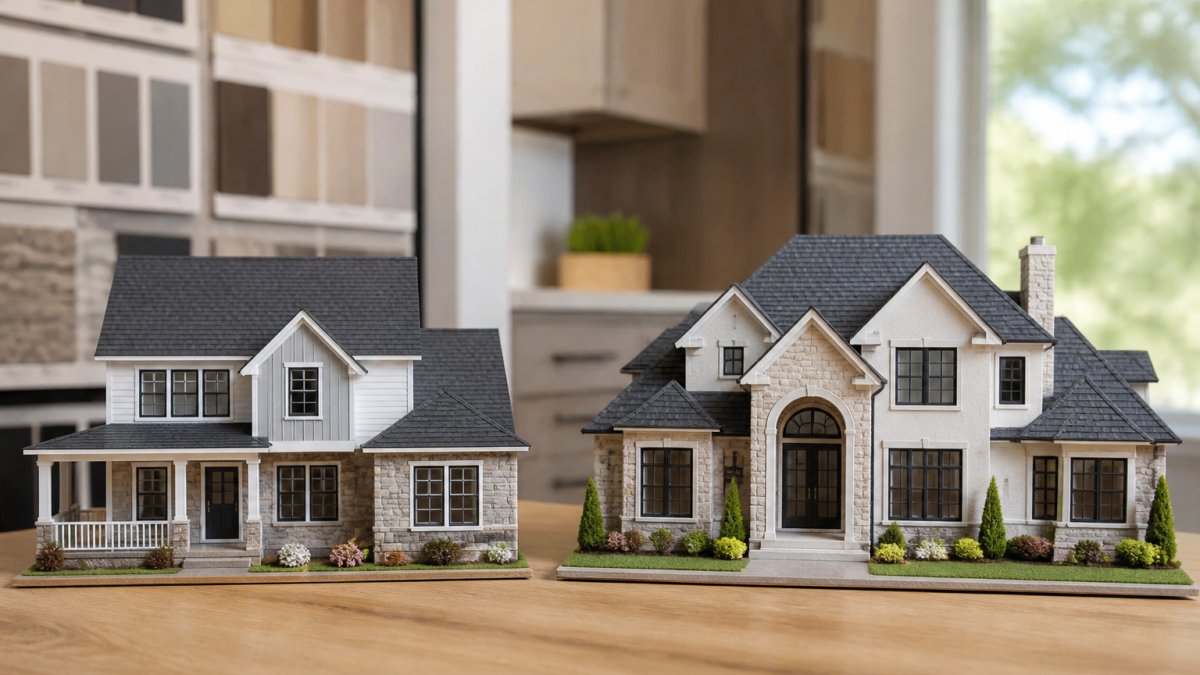
Choosing between semi-custom vs custom homes comes down to one question: how much control do you actually need? A semi-custom home starts from a proven floor plan and lets you adjust finishes, fixtures, and some layout details. A custom home starts with a blank lot and an architect.
Semi-Custom vs Custom Homes: A Side-by-Side Comparison
The clearest way to see the semi-custom vs custom homes trade-off is a direct comparison. Semi-custom builds trade design freedom for predictability. Custom builds trade predictability for total control.
| Factor | Semi-Custom | Custom |
|---|---|---|
| Starting point | Builder's existing floor plan | Blank lot, architect-led design |
| Design control | Finish selections, minor layout changes | Full architectural and structural control |
| Construction timeline | Shorter, proven build sequence | Longer, more design and permitting phases |
| Budget predictability | Higher, fewer variables | Lower, change orders add up |
| Best for | Buyers wanting personalization without risk | Buyers with a specific vision and flexibility |
Average Cost to Build a Custom Home vs Semi-Custom
Exact figures vary by lot, region, and finish level, so treat any single number with suspicion. What matters is the structure of the cost gap: custom builds carry architectural fees, engineering, and site-specific design that semi-custom builds spread across many homes. A semi-custom build reuses a floor plan the builder has constructed before. That repetition lowers design cost and reduces the chance of expensive surprises.
Where the Cost Gap Actually Comes From
The gap is not one line item. It is a stack of them:
- Architectural and design fees. Custom builds pay for original drawings, revisions, and often a separate interior designer. Semi-custom buyers select from a builder's existing plan library, so the design cost is amortized across every home built from that plan.
- Structural engineering. Moving a wall in a semi-custom home is usually a finish-level change. Moving a wall in a custom home can trigger beam sizing, foundation adjustments, and re-inspection.
- Site-specific design. A custom plan is drawn for one lot's slope, soil, orientation, and setbacks. A semi-custom plan is drawn for a typical lot and adjusted at the margins.
- Permitting complexity. Custom plans often face longer plan-review cycles because reviewers are seeing the drawings for the first time. Semi-custom plans in an established community are frequently pre-approved or fast-tracked.
- Finish allowances. Both paths use allowances, but custom builds tend to set them higher and exceed them more often.
Budget Allocation and Hidden Costs of Customization
The hidden costs of customization are where custom budgets break. Common line items buyers miss:
- Change orders during construction, each one priced at a premium because the trade is already mobilized
- Site engineering for slopes, drainage, or soil issues that only surface after excavation
- Upgraded finishes that exceed the base allowance, tile, cabinetry, and lighting are the usual culprits
- Permitting delays that extend carrying costs on the construction loan, since interest accrues during the delay
- Landscaping and driveway work often excluded from the build contract
- Utility connections and impact fees that vary by jurisdiction and are rarely in the headline price
Financing and Construction Loans
Construction financing works differently from a standard mortgage. A construction loan typically covers the build in draws released as work completes, then converts to a permanent mortgage at completion. That structure means your interest cost is tied to how long the build takes, which is exactly why the timeline section matters to your budget.
- Draw schedules. How many draws, and what inspection triggers each one? A slow draw schedule can stall your build even when the loan is approved.
- Conversion terms. What rate and term will the loan convert to, and is that locked or floating?
The Custom Home Design Process: Steps and Decisions
The custom home design process steps follow a predictable arc, even though every project differs. Understanding the sequence helps you spot where delays and costs accumulate.
- Site selection and evaluation - confirm buildability, utilities, and setbacks
- Architect engagement - translate your vision into drawings
- Design development - refine layout, materials, and systems
- Engineering and documentation - structural, mechanical, and permit drawings
- Bidding and contractor selection - compare scope, not just price
- Permitting - local review and approval
- Construction - foundation through finishes
Architectural Design and Permitting
Architectural design and permitting are the two phases where custom builds lose the most time. Each design revision can trigger re-engineering. Each permit cycle depends on your local building department's workload.
Semi-Custom Home Construction Timeline Compared to Custom
The semi-custom home construction timeline is shorter for one reason: fewer unknowns. A proven plan means crews, materials, and inspections follow a familiar sequence.
Resale Value and Energy Efficiency: Which Build Wins?
Resale value and energy efficiency favor different paths depending on your priorities. A custom home can be engineered for higher performance, but that investment doesn't always return at sale. Semi-custom homes in established communities often appraise more predictably, because buyers in those neighborhoods compare against similar homes, which stabilizes value.
Resale Value: Comparables vs. Uniqueness
Appraisers rely on comparable sales. A semi-custom home in a subdivision has many comps, similar square footage, similar lot, similar finish level, so its value is easy to defend. A custom home may have few or no true comps, which cuts both ways: a distinctive home can command a premium from the right buyer, or sit on the market because the pool of buyers who want that specific design is small.
Energy Efficiency and Green Building Certifications
Energy efficiency is where custom builds can pull ahead, and it is also where the SERP is thinnest. A custom home can be designed around site-specific orientation, window placement, and envelope detailing in ways a stock plan cannot. That opens the door to recognized certifications:
- LEED (Leadership in Energy and Environmental Design), a points-based green building certification administered by the U.S. Green Building Council, covering energy, water, materials, and indoor environmental quality.
- ENERGY STAR Certified Homes, a program run by the U.S. Environmental Protection Agency that sets performance thresholds for the building envelope, HVAC, and ductwork.
- Passive House, a performance standard focused on airtightness, insulation, and heat recovery ventilation, with certification paths for both single-family and multifamily homes.
The Financing Angle Most Guides Miss
Energy-efficient features can affect your financing, not just your utility bill. Some lenders offer energy-efficient mortgages that allow a buyer to finance efficiency improvements or qualify for a larger loan based on projected energy savings. Ask your lender whether the program applies to new construction and what documentation the certification requires. This is a concrete way the custom path can pay back before resale.
| Priority | Better Path |
|---|---|
| Predictable resale | Semi-custom in an established community |
| Maximum performance | Custom with efficiency-focused design |
| Faster move-in | Semi-custom |
| Unique design | Custom |
| Green certification | Custom, designed for LEED, ENERGY STAR, or Passive House |
| Lower monthly utility cost | Custom with envelope and HVAC upgrades |
Pros and Cons: Which Build Path Fits Your Family?
Neither path wins outright. The right choice depends on how you weigh control against certainty.
Semi-custom pros:
- Lower cost and more predictable budget
- Faster timeline and move-in
- Proven floor plans reduce design regret
Semi-custom cons:
- Limited structural changes
- Less architectural freedom
Custom pros:
- Total control over design and materials
- Site-specific engineering and efficiency options
Custom cons:
- Higher cost with more hidden variables
- Longer timeline and more decisions
Conclusion
The pros and cons of semi-custom vs custom homes come down to how much uncertainty you can absorb. Semi-custom offers speed and budget control. Custom offers total design freedom at a higher cost and longer timeline.
Frequently Asked Questions
What are the key differences between custom and semi-custom homes?
A fully custom home is designed from scratch to your exact specifications, including architectural design, floor plan, and site engineering. A semi-custom home starts with a proven floor plan from a builder's portfolio that you can modify within set limits, such as moving interior walls or selecting finishes. The main differences come down to design control, cost, and timeline. Custom builds offer unlimited personalization but take longer and cost more, while semi-custom builds balance personalization with predictability.
Is a semi-custom home cheaper than a fully custom build?
Yes, semi-custom homes typically cost less because they use existing architectural plans and allow only limited structural modifications, which reduces design fees and change orders. However, pricing depends on the size, location, and finishes you choose. For a personalized estimate on your project, contact Handy Gonzo's Home Improvements for a free consultation.
How much design flexibility do you lose with a semi-custom home?
With a semi-custom home, you can usually choose from a set of floor plans and make non-structural changes like selecting cabinets, countertops, flooring, and paint colors. You may also be able to add square footage or rearrange interior walls, but major structural modifications are often restricted. If you want full control over every detail, including site-specific architectural design, a custom home is the better fit. Otherwise, semi-custom offers a good balance.
What is the typical timeline difference between custom and semi-custom construction?
Semi-custom home construction timelines are generally shorter because the design phase is streamlined and many decisions are pre-made. A semi-custom build might take 6 to 10 months, while a fully custom home often takes 9 to 18 months or more, depending on permitting, site engineering, and complexity. Factors like weather, material availability, and change orders can also affect the schedule. Always ask your builder for a detailed project timeline.
How do financing and construction loans differ for custom vs semi-custom homes?
Construction loans for both custom and semi-custom homes typically require a larger down payment and have higher interest rates than traditional mortgages. Lenders may view semi-custom builds as lower risk because they follow established plans and timelines. For custom homes, you may need to provide more detailed architectural plans and a realistic budget before approval. It's wise to get pre-approved and discuss your options with a lender early in the process.