 comparison
Custom vs Stock Kitchen Cabinets: Pricing Guide
Table of Contents
- Stock vs Custom Cabinets: How Pricing Really Compares
- Average Cost of Kitchen Cabinets Per Linear Foot
- Factors Affecting Custom Cabinet Pricing
- Quality and Material Differences: Stock vs Custom
- Kitchen Cabinet Installation Cost: What to Expect
- Lead Times and the Total Cost of Ownership
- Decision Matrix: Which Cabinet Type Fits Your Kitchen?
- Conclusion
- Frequently Asked Questions
Last Updated: September 8, 2026
Stock vs Custom Cabinets: How Pricing Really Compares
The gap between custom kitchen cabinets vs stock cabinets pricing isn't just about the sticker price. It's about what you're actually buying: a pre-manufactured product built to standard sizes versus a bespoke piece designed around your exact kitchen footprint. We've installed both across three and a half decades of remodeling projects.
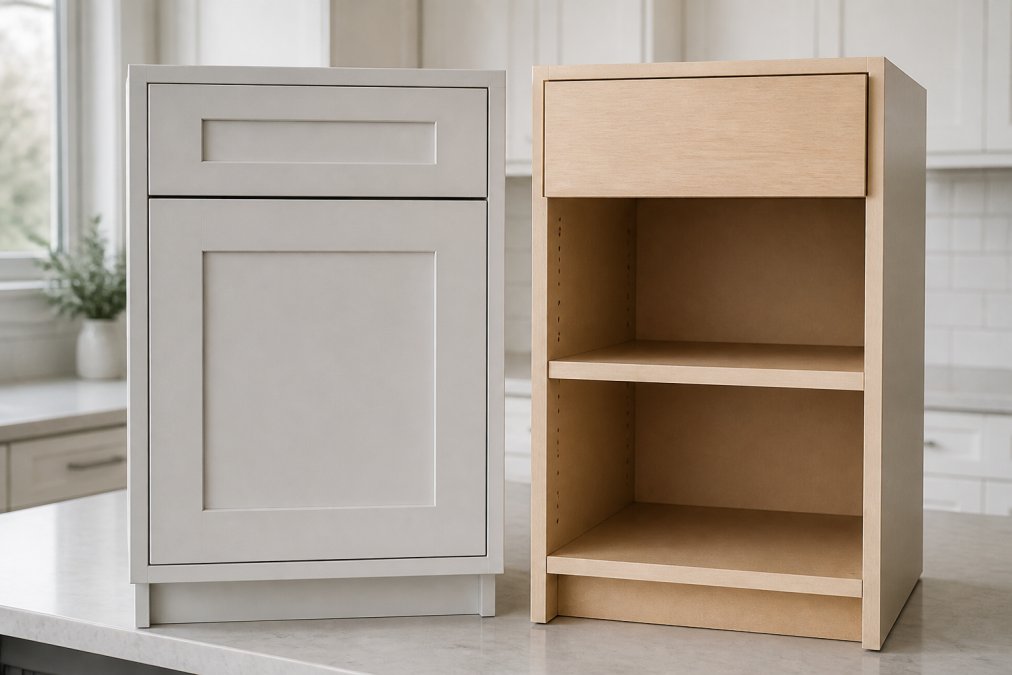
Stock cabinets are pre-manufactured units sold in standard sizes at big-box stores and home centers. Custom cabinets are built to order around your specific dimensions, material preferences, and aesthetic requirements.
Below, we break down the actual cost drivers, material differences, and hidden expenses that rarely show up in a simple price comparison.
Average Cost of Kitchen Cabinets Per Linear Foot
Stock cabinets typically run between $75 and $300 per linear foot, while fully custom cabinetry starts around $500 per linear foot and climbs from there (homeadvisor.com). Semi-custom options generally fall between $150 and $500 per linear foot (Cuisine Idéale Semi-Custom Cabinets, 2026). Ready-to-assemble (RTA) cabinets can start around $100 per linear foot (CabStone Cabinetry, 2026).
Linear foot pricing measures the total width of your lower cabinets plus your upper cabinets, calculated along the wall. A typical kitchen runs 20 to 30 linear feet, so the spread between stock and custom can reach tens of thousands of dollars.
That baseline only covers the boxes and doors, not installation labor, hardware upgrades, or accessories.
| Cabinet Type | Starting Price Per Linear Foot | Availability | Customization |
|---|---|---|---|
| Stock | $75 | Immediate | Standard sizes only |
| RTA | $100 | In stock | Assembly required |
| Semi-Custom | $150 | 2-4 weeks | Some size flexibility |
| Custom | $500 | 6-12 weeks | Fully bespoke |
Breaking Down the Per-Foot Numbers
A typical 10-foot wall with both upper and lower cabinets equals 20 linear feet. At the low end, a stock cabinet package for that wall might cost $1,500; the same wall with custom cabinetry starts at $10,000.
Here is what those per-foot figures actually include at each tier:
Stock Cabinets ($75-$300 per linear foot):
- Particle board or MDF boxes with melamine or thermofoil finishes
- Standard 12-inch, 18-inch, 24-inch, 30-inch, and 36-inch widths
- Factory-installed hinges with standard 3/4-inch overlay
- No design consultation or site measurement included
- Delivery to your door only; you handle moving units into place
RTA Cabinets ($100-$350 per linear foot):
- Flat-packed boxes with cam-lock assembly hardware
- Same standard size increments as stock
- You assemble and install, saving 15-20% on labor
- Quality varies widely by manufacturer; check box construction before ordering
Semi-Custom Cabinets ($150-$500 per linear foot):
- Plywood boxes with a wider range of door styles and finishes
- Size adjustments in 1-inch increments beyond standard widths
- Some design consultation included in the quote
- Manufacturer lead time of 2-4 weeks plus installation scheduling
Custom Cabinets ($500-$1,200+ per linear foot):
- Cabinet-grade plywood or solid wood throughout
- Any dimension, including angled, curved, or non-standard heights
- Full design service with shop drawings and material samples
- Hand-finished doors and drawer fronts
- On-site templating and installation coordination
Real Project Cost Examples
To ground these numbers, here are typical scenarios based on current market rates:
Small Galley Kitchen (15 linear feet):
- Stock: $1,125-$4,500 for cabinets
- Semi-Custom: $2,250-$7,500
- Custom: $7,500-$18,000
Medium L-Shaped Kitchen (25 linear feet):
- Stock: $1,875-$7,500
- Semi-Custom: $3,750-$12,500
- Custom: $12,500-$30,000
Large U-Shaped Kitchen (35 linear feet):
- Stock: $2,625-$10,500
- Semi-Custom: $5,250-$17,500
- Custom: $17,500-$42,000
These ranges assume standard installation conditions. Add 10-15% for demolition, drywall repair, or floor leveling, and another 10% for upgraded hardware or specialty accessories.
What the Per-Foot Price Does Not Include
The per-linear-foot figure is a starting point, not a final quote. Every cabinet project carries additional costs that rarely appear in the initial comparison:
- Design fees: Custom shops often charge $500-$2,000 for detailed drawings, though many waive this if you proceed with their fabrication
- Delivery and staging: Stock cabinets ship freight; expect $150-$400 depending on order size
- Hardware upgrades: Soft-close hinges add $3-$8 per hinge; full-extension drawer slides add $10-$25 per drawer
- Interior accessories: Pull-out shelves, spice racks, and waste bins run $50-$300 per unit
- Crown molding and trim: Matching your cabinets to your ceiling often requires additional material and labor
Regional Price Variations
Labor and material costs vary by region. Urban coastal areas typically run 15-25% higher than the national average; rural markets and the Southeast often come in below average.
Get three quotes from local suppliers and compare them against these benchmarks; the spread often reveals where a contractor is cutting corners.
Factors Affecting Custom Cabinet Pricing
Custom cabinet pricing escalates based on four primary factors: material quality, construction method, finish complexity, and the number of specialized interior fittings. Each decision you make pushes the final number in a different direction.
Material selection is the biggest lever. Solid wood species like cherry, walnut, and maple cost substantially more than plywood or MDF cores with wood veneers.
Joinery quality compounds the cost. Dovetail drawers, soft-close hinges, and full-extension slides add labor and materials to every cabinet box.
Finish durability is another variable. A sprayed lacquer or conversion varnish costs more but holds up better against moisture and daily wear.
Quality and Material Differences: Stock vs Custom
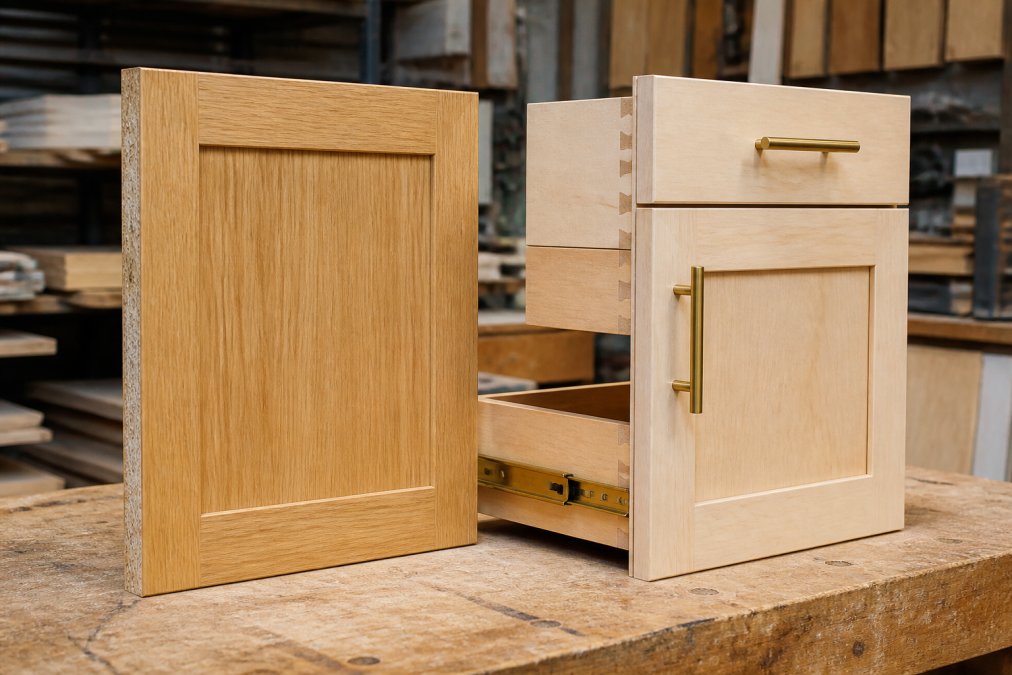
The most significant quality gap between stock and custom cabinetry lies in the box construction, not the door style. Stock cabinets commonly use particle board for the cabinet body, which swells and degrades when exposed to moisture over time.
Custom cabinets typically use cabinet-grade plywood or solid wood throughout the carcass. Plywood resists moisture better, holds screws more securely, and stands up to years of use without hinges pulling loose.
Soft-close hinges and dovetail drawers are standard on quality custom work but are often upcharges on stock lines. The difference in daily use is immediate and compounds over a decade.
Factory-applied stock finishes are durable enough, but custom shops offer more control over color matching, glaze effects, and final sheen, often the deciding factor for homeowners chasing a specific aesthetic.
Kitchen Cabinet Installation Cost: What to Expect
Installation labor typically adds a significant percentage to your cabinet budget, and the complexity of your layout determines how much. Stock cabinets in standard sizes install quickly; custom installations take longer to accommodate uneven floors, angled walls, and appliance clearances.
Labor rates vary by market, but structural work multiplies costs. Removing old cabinetry, repairing drywall, adjusting rough-ins, and leveling floors all add to the final invoice.
Big-box stores often subcontract to third-party crews; a dedicated, multi-trade team can handle the full scope from demolition through trim work, reducing coordination headaches.
Lead Times and the Total Cost of Ownership
Stock cabinets are available immediately, while custom orders typically require six to twelve weeks of lead time (CabStone Cabinetry, 2026). That waiting period influences your total cost of ownership, a metric most pricing guides ignore.
Total cost of ownership (TCO) includes purchase price, installation, and replacement over the cabinet's usable life. A budget stock kitchen might save money upfront, but if the boxes deteriorate within a decade, you're paying for a second installation sooner than planned.
Custom cabinets built with solid materials and quality joinery routinely last 20 to 30 years with proper care (cabinetmakers.org). The annualized cost of a $15,000 custom kitchen over three decades can rival a $6,000 stock kitchen replaced twice in the same period.
Warranty coverage also differs. Stock cabinets carry limited warranties that often exclude installation defects; custom builders typically stand behind their workmanship, though specific terms vary.
The Annualized Cost Calculation
To make the TCO comparison concrete, consider a typical 25-linear-foot kitchen and project its costs over a 30-year ownership horizon:
Scenario A: Stock Cabinets ($6,000 purchase)
- Installation: $1,500
- Expected lifespan: 8-12 years before visible wear (particle board swelling near the sink, hinge pull-out, finish peeling)
- Replacement at year 10: $6,000 + $1,500 (adjusted for inflation)
- Second replacement at year 20: $6,000 + $1,500
- Total cost by year 30: approximately $24,000-$27,000
- Annualized cost: $800-$900 per year
Scenario B: Semi-Custom Cabinets ($10,000 purchase)
- Installation: $2,500
- Expected lifespan: 15-20 years with plywood boxes and upgraded hardware
- One replacement at year 17: $10,000 + $2,500
- Total cost by year 30: approximately $25,000
- Annualized cost: $830 per year
Scenario C: Custom Cabinets ($18,000 purchase)
- Installation: $4,000
- Expected lifespan: 25-35 years with solid wood construction and dovetail joinery
- No replacement needed within 30 years; minor hardware swaps at year 15 ($500)
- Total cost by year 30: approximately $22,500
- Annualized cost: $750 per year
These figures reveal a counterintuitive result: the custom kitchen can cost less per year of use than the stock kitchen that requires two replacements.
Maintenance and Repair Cost Differences
The TCO gap widens when you factor in maintenance and repair costs:
Stock Cabinet Repairs:
- Particle board boxes cannot be reliably repaired once they swell or delaminate, replacement is the only option
- Hinges that pull out of particle board require wood filler and repositioning, which weakens the box further
- Door fronts are often discontinued within 3-5 years, making single-door replacement impossible
- Finish touch-ups rarely match because factory finishes are batch-applied
Custom Cabinet Repairs:
- Plywood and solid wood boxes accept new screws and hinges without structural failure
- Individual doors and drawer fronts can be replicated by the original shop, even years later
- Finishes can be matched and touched up by hand
- Hardware is standard-sized and replaceable without modifying the box
A stock cabinet with a failed drawer slide costs $150-$300 to repair if the box is intact, but $600-$1,200 to replace if the box has deteriorated. Custom cabinets with the same issue typically cost $50-$150 for a new slide because the box remains sound.
The Hidden Cost of Lead Time
Lead time itself carries a financial weight that most pricing comparisons ignore. If your renovation timeline stretches from 4 weeks (stock) to 12 weeks (custom), you may face:
- Extended temporary kitchen costs: Eating out or using a temporary kitchen setup for 8 additional weeks at $100-$200 per week
- Carrying costs on your renovation loan: Interest accrues during the entire project, not just the active work weeks
- Lost rental income: For investment properties, each week of vacancy represents $200-$500 in lost rent
- Opportunity cost of delayed occupancy: If you're paying rent elsewhere while your kitchen is renovated, every extra week adds to your out-of-pocket total
For a homeowner renovating while living in the house, the lead time difference may be manageable. For a landlord or flipper, an 8-week delay can erase the savings from choosing stock cabinets.
When the TCO Math Favors Stock
The TCO analysis does not always favor custom. Stock cabinets win on total cost when:
- You plan to sell within 5 years: The next owner may remodel anyway, so the premium for longevity is wasted
- The kitchen is in a rental property: Tenants cause wear that shortens any cabinet's lifespan; cheap and replaceable beats expensive and durable
- Your layout is perfectly standard: If stock sizes fit without filler strips or modifications, the installation cost stays low
- You are flipping a house: Buyers expect a new kitchen but rarely pay a premium for custom construction in a mid-range home
Resale Value and TCO
Resale value adds another layer to the TCO equation. Real estate appraisers generally assign more value to a kitchen with plywood boxes and quality hardware than to one with particle board construction, regardless of the door style. A custom kitchen can recover 60-80% of its cost in increased home value, while stock cabinets typically recover 40-60% (remodeling.hw.net).
That recovery rate depends on your neighborhood and the overall quality of your home. A custom kitchen in a $200,000 house may not move the needle; the same kitchen in a $600,000 house can be the deciding factor for buyers. Match your cabinet investment to your home's value tier to avoid over-improving or under-improving for your market.
Decision Matrix: Which Cabinet Type Fits Your Kitchen?
Match the cabinet type to your renovation's scope, timeline, and how long you plan to stay in the home. A decision matrix helps clarify the trade-offs before you commit.
| Your Situation | Recommended Type | Why |
|---|---|---|
| Flipping a property, tight timeline | Stock | Immediate availability, lowest cost |
| Rental unit, basic function | RTA or Stock | Budget-friendly, replaceable |
| Family kitchen, 10+ year plan | Semi-Custom | Better materials, layout flexibility |
| Dream kitchen, unique layout | Custom | Perfect fit, premium materials |
| Aging-in-place or accessibility needs | Custom | Precise dimensions for mobility access |
For a quick renovation or a rental property, stock cabinets handle the job without overthinking it. The standard sizes fit most layouts, and the price point protects your return on investment.
For a primary residence where you'll cook daily for the next decade, semi-custom offers the best value. You get better construction and more size options than stock without paying the full bespoke premium.
Custom cabinetry earns its cost when your kitchen has unusual dimensions, when you need specific accessibility modifications, or when you want a truly one-of-a-kind result. The design flexibility and material quality justify the investment for homeowners who view their kitchen as a long-term asset.
Conclusion
Choosing between custom kitchen cabinets vs stock cabinets pricing means weighing upfront costs against longevity, lead times, and how the cabinets perform in daily use. Stock works for quick turnarounds and tight budgets. Custom delivers precise fitment, superior materials, and decades of reliable service.
The installation quality matters as much as the cabinets themselves. A poorly installed premium cabinet performs worse than a well-installed stock unit. Working with a team that provides a clear breakdown of materials, labor, and timeline before work begins removes surprise-cost anxiety.
Our dedicated multi-trade crew handles everything from demolition to final trim, keeping your home livable throughout the process. With over 35 years of construction experience and transparent digital quoting, we help you match the right cabinet type to your budget and your goals. Get a free estimate and see exactly what your kitchen renovation will cost before you commit.
Frequently Asked Questions
What is the average price difference between stock and custom cabinets?
Stock cabinets typically run $75 to $300 per linear foot, while custom cabinets start around $500 per linear foot and can climb higher depending on materials and finish. That means you could pay two to six times more for custom work. The gap reflects differences in construction quality, material grade, and the labor required to build to your exact specifications.
Is it cheaper to build your own cabinets or buy premade?
Building your own cabinets can be cheaper on materials alone, but only if you already own professional-grade tools and have solid woodworking skills. Mistakes cost money, and most homeowners underestimate the time involved. For most people, buying stock or semi-custom cabinets from a big-box store or working with a contractor on custom builds delivers better results for the price.
Do custom cabinets increase home resale value?
Custom cabinets can increase resale value, but they rarely return their full cost. Real estate appraisers typically value a kitchen based on the overall quality and condition of the renovation, not the individual cabinet choice. If your custom cabinets are part of a cohesive, high-end kitchen remodel, they help your home sell faster and at a higher price. Stock cabinets in good condition also hold value well for budget-conscious buyers.
Are there hidden costs when choosing custom cabinetry?
Yes. Custom cabinetry often comes with hidden costs beyond the quoted cabinet price. Design consultation fees, premium hardware upgrades, specialty storage inserts, and delivery charges can add up quickly. You also need to budget for a longer project timeline, which means additional weeks of labor costs and eating out if your kitchen is out of commission. Get a detailed written quote that itemizes every component before you commit.