 ultimate-guide
Avoiding Surprise Costs in Home Renovation: A 2026 Guide
Table of Contents
- Why Home Renovations Blow Past Their Budgets
- How to Read a Construction Estimate Like a Pro
- The Role of a Home Renovation Contingency Fund
- Common Hidden Remodeling Costs That Catch Owners Off Guard
- Managing Contractor Change Orders Without the Stress
- Financing Choices and Their Impact on Your Final Bill
- Contract Red Flags and Questions to Ask Before You Sign
- Conclusion: Your Action Plan for a Predictable Renovation
- Frequently Asked Questions
Last Updated: September 5, 2026
Why Home Renovations Blow Past Their Budgets
Most budgets don't fail because of one catastrophic mistake. They fail because of a dozen small misses that compound over weeks. A home renovation is a sequence of decisions, and each one carries a price tag that can drift from the original estimate.
The gap usually starts with the estimate itself. Many homeowners receive a number, assume it covers everything, and discover later that demolition, haul-away, and permit fees were never itemized. At Handy Gonzo's Home Improvements, we've spent over 35 years watching this pattern repeat, which is why we emphasize clear digital quotes that break down materials, labor, and timeline before a single wall comes down.
The psychology matters too. When you're deep into a project, the desire to just finish can override financial discipline. That emotional pressure is exactly what avoiding surprise costs in home renovation requires you to plan against, not just with a spreadsheet, but with clear decision rules you set before construction begins.
How to Read a Construction Estimate Like a Pro
A construction estimate is a legal document disguised as a friendly list. Every line item matters, but the real signal is in what's missing.
Start by checking for scope clarity. Does the estimate specify exact materials, brands, and model numbers? Vague terms like "builder's grade" or "mid-range fixtures" leave room for substitutions later. A common mistake is assuming the lowest bid is the best value. In practice, a low bid often signals omitted work that will surface as change orders after you're committed.
Fixed-Price vs. Cost-Plus Contracts
The contract type determines your risk exposure. A fixed-price contract puts the risk of material escalation and labor overruns on the contractor. A cost-plus contract passes those costs directly to you, plus a percentage fee.
Cost-plus arrangements demand rigorous oversight. You should require itemized invoices for every material purchase and a clear definition of what constitutes "direct cost." According to guidance from the Federal Trade Commission on home improvement contracts, getting the full scope of work in writing before signing is essential to protect yourself. If a contractor hesitates to itemize, that's a red flag.
The Role of a Home Renovation Contingency Fund
A home renovation contingency fund is money set aside specifically for unexpected costs that arise during construction. Most industry guidance suggests reserving 10 to 20 percent of your total project budget for this purpose (consumer.ftc.gov). That range is a starting point, not a rule. The right percentage depends on the age of your home, the scope of your project, and how invasive the work is. A new kitchen in a 1970s house with original wiring warrants a higher reserve than a cosmetic bathroom update in a home you've already fully rewired.
This fund exists for genuine surprises, not for upgrades. The discipline of avoiding surprise costs in home renovation means you protect this reserve. When you're tempted to swap standard fixtures for premium ones, that's a scope change, not an emergency. The contingency covers hidden defects, structural issues, and code violations discovered after walls are opened.
The Financing Angle Most Guides Miss
Where this gets tactical is how you hold and deploy that contingency when you're not paying cash. If you're using a renovation loan or a home equity line of credit (HELOC), the structure of your financing changes how you should think about this reserve.
With a HELOC, you only pay interest on what you draw. That means your contingency fund can stay undrawn in the line of credit until you actually need it, rather than sitting in a savings account earning minimal interest. You are not paying interest on money you haven't spent. This is a meaningful advantage over a lump-sum construction loan, where you may be paying interest on the full principal from day one, including the portion you set aside for surprises.
A standard 203(k) renovation loan, insured by the Federal Housing Administration, works differently. The lender disburses funds in draws as work progresses, and your contingency is typically built into the total loan amount. If you don't use it, you still pay interest on it for the life of the loan. That creates a subtle pressure: you've already borrowed the money, so the marginal cost of using it feels lower than it should. Guard against that by treating the contingency as a separate line item in your tracking spreadsheet, not as a pool of 'extra' money that's already been spent.
Draw Schedules and the Timing Trap
A second financing trap is the draw schedule. Lenders release funds in stages tied to project milestones. If your contractor hits an unexpected structural issue in week two, but your next draw isn't scheduled until the framing inspection in week six, you have a cash flow gap. The contractor may ask you to cover the cost out of pocket, expecting reimbursement from the next draw. That is a legitimate request, but it must be documented as a formal change order with a clear reimbursement timeline. If the lender's inspection fails, that reimbursement can be delayed for weeks, and you are left holding the bill.
Before you sign a loan agreement, ask your lender for the exact draw schedule and map it against your project timeline. If there's a long gap between the demolition draw and the rough-in inspection, plan for that specific window to be your highest-risk period for out-of-pocket exposure.
Common Hidden Remodeling Costs That Catch Owners Off Guard
The most frequent surprise isn't the cost of the new tile. It's the cost of what's behind the old tile.
Structural Issues, Permits, and Code Compliance
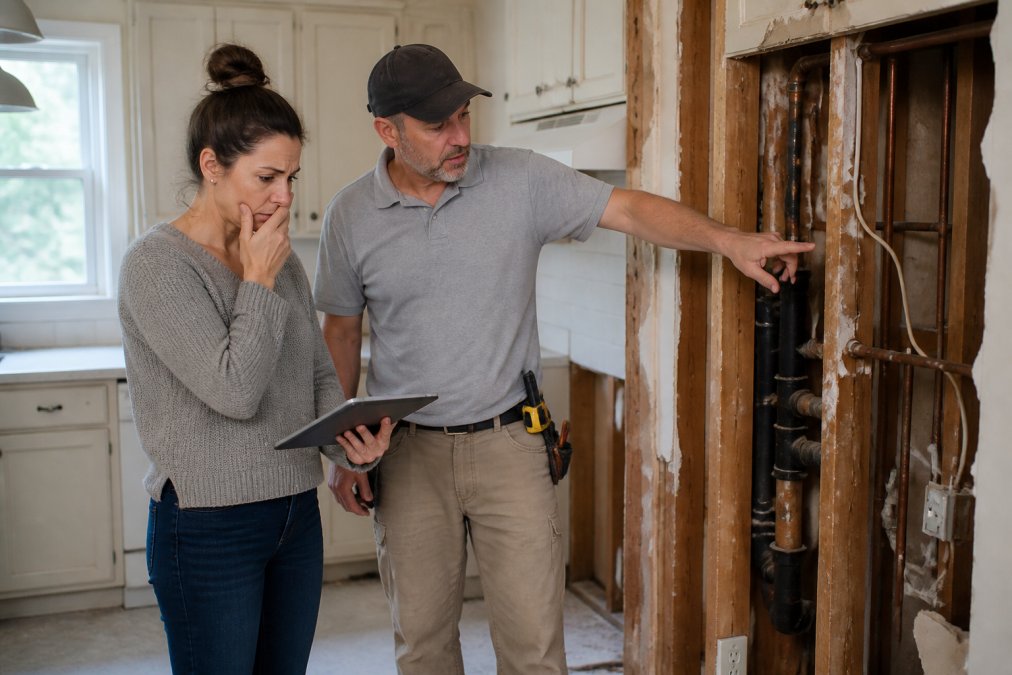
Opening a wall can reveal rotting framing, outdated electrical wiring, or plumbing that doesn't meet current code. Fixing these issues is non-negotiable, and the cost is entirely dependent on what you can't see before demolition. Building permits and zoning regulations also add fees that vary by municipality, and failing to pull the right permits can lead to fines and complications when you sell the home.
Material Price Fluctuations and Labor Costs
Material costs can shift between your estimate and your actual purchase date. Lumber, copper, and specialty finishes all fluctuate. Labor costs can rise if the project timeline extends, especially if subcontractor fees are involved. A fixed-price contract shields you from material escalation, but only if the contract explicitly states that.
The Displacement Tax: What Living Through a Reno Really Costs
There is a category of cost that almost no guide addresses: the cost of living in a house that is under construction. This is not a line item on any contractor's estimate, but it is a real expense that erodes your budget.
If your kitchen is out of commission for six weeks, every meal is a decision. The average family of four in the United States spends roughly $300-$600 per week on groceries. When you lose your kitchen, that number climbs because you shift to prepared foods, takeout, and restaurant meals. Over a 10-week kitchen remodel, that premium can easily reach $1,000-$2,000. It's not a single invoice you can dispute; it's dozens of small transactions that quietly drain your contingency fund.
A bathroom remodel creates a different version of the same problem. If you have one bathroom and it's unusable for three weeks, you need an alternative. Options include a gym membership with shower facilities (roughly $30-$60 per month, but you may need a month-to-month plan), staying with family, or renting a hotel room for critical nights. A modest hotel stay at $120-$180 per night for a weekend adds up fast. The cheapest solution is often to schedule the work in phases so the toilet and shower are never both out of service at the same time, but that requires your contractor to plan the sequence carefully.
The Time Cost of Managing the Project
There is also the cost of your own time. A renovation project demands decisions: tile selections, fixture approvals, site visits, and progress checks. Most homeowners underestimate how many hours this takes. If you are taking time off work to meet inspectors or contractors, that is lost income or lost vacation days. A common pattern is 5-10 hours per week of active management during a major remodel. At an average hourly wage, that is a real economic cost that never appears on a budget sheet.
How to Budget for These Invisible Costs
Before you finalize your project budget, add a separate line item for 'displacement and management costs.' A reasonable starting point is 3-5 percent of your total project budget, on top of your contingency fund. This is not the same as your contingency. Your contingency covers surprises in the physical work. This line item covers the cost of your life being disrupted. If you finish under budget, you've saved money. If you don't plan for it, you will pull from your contingency, and then you'll have less protection when a real structural surprise appears.
Managing Contractor Change Orders Without the Stress
A change order is a formal amendment to your original contract that documents a change in scope and its associated cost. Managing contractor change orders effectively requires a simple rule: no verbal approvals, ever.
Every change, no matter how small, must be documented in writing with a clear price before the work proceeds. This protects both you and the contractor. A professional contractor will welcome this process because it ensures they get paid for legitimate extras. A contractor who resists written change orders is often planning to surprise you with costs later. This is the core of how to manage a renovation project budget effectively.
Financing Choices and Their Impact on Your Final Bill
How you pay for the renovation affects the total cost as much as the materials you choose. Using a home equity line of credit or a construction loan means interest accrues during the project, which adds to your final bill if timelines slip.
Cash payments avoid interest but reduce your flexibility. Credit cards offer convenience but typically carry high rates. The psychological cost of renovation also ties into financing. When you're paying interest on a drawn-out project, the pressure to accept incomplete work or rush decisions grows. A realistic budget and a contingency fund reduce that stress, making it easier to stick to your plan.
Contract Red Flags and Questions to Ask Before You Sign
Several warning signs should make you pause before signing any agreement with a contractor. A request for a large upfront payment before work begins, typically more than a third of the total, is one. Vague descriptions of materials, as noted earlier, and a refusal to put change order procedures in writing are others.
Ask direct questions: Who exactly will be on site each day? How often will I receive progress updates? What is the procedure for handling unexpected discoveries? How will the job site be kept clean and safe? A contractor with a dedicated, multi-trade crew, like the one at Handy Gonzo's Home Improvements, can answer these questions clearly because the same people handle the project from start to finish.
Conclusion: Your Action Plan for a Predictable Renovation
Avoiding surprise costs in home renovation comes down to preparation, clear contracts, and disciplined decision-making. Set a realistic budget that includes a contingency fund, insist on itemized written estimates, and manage every change through a formal order process.
The right contractor makes this easier. Handy Gonzo's Home Improvements pairs transparent digital quoting with a consistent crew, so you know who is in your home and what the work will cost before it starts. We keep job sites clean daily and communicate clearly throughout the project. Avoiding surprise costs is about trust, and trust is built on clarity. Get a Free Estimate from Handy Gonzo's Home Improvements and start your renovation with confidence.
Frequently Asked Questions
How much of a contingency fund should I set aside for renovations?
A contingency fund of 10-20% of your total project budget is the standard safeguard. For older homes with outdated systems, lean toward the 20% end because hidden defects are more likely. For newer homes or cosmetic updates, 10% may suffice. This fund exists to absorb costs from unexpected structural issues or material price changes without forcing you to pause the project or take on more debt.
What are the most common hidden costs in a home remodel?
The most frequent hidden costs include opening walls to find outdated electrical wiring, plumbing retrofits, or HVAC system upgrades needed for code compliance. Permit fees, waste disposal, and unexpected structural repairs also add up. Many homeowners forget to budget for the ripple effect of their choices, such as moving a wall that forces new ductwork. A thorough pre-construction planning phase helps identify many of these before demolition starts.
What is the difference between a fixed-price contract and a cost-plus contract?
A fixed-price contract sets a total project cost upfront, so you pay that amount regardless of actual contractor expenses, making it easier to budget. A cost-plus contract requires you to pay the actual cost of materials and labor plus a percentage fee for the contractor. Fixed-price contracts protect you from cost overruns but require very detailed specs. Cost-plus contracts offer transparency but put the risk of escalation on you.
How can I ensure my contractor provides an accurate, transparent quote?
Ask for a quote that itemizes materials, labor, and project timeline. Make sure the quote lists specific products and finishes, not just allowances. A contractor who performs a detailed site inspection before quoting is more likely to catch issues that lead to change orders. Ask how they handle unexpected findings and confirm that all subcontractor fees are included. Clear expectations before work begins prevent disputes later.
What is the smartest way to finance a home renovation project?
The best financing option depends on your equity and the project size. A home equity line of credit often offers lower interest rates than personal loans. Cash is always the cheapest option because it avoids interest entirely. Your financing choice impacts your total cost, so factor in interest rates when calculating the true price of the renovation. Your contractor can often start the estimate process before you finalize the loan.