 listicle
5 Best Bathroom Flooring for Humid Climates
Table of Contents
- Why Humidity Matters for Bathroom Flooring Choices
- Bathroom Flooring Comparison Table
- 1. Porcelain Tile: Maximum Durability and Moisture Resistance
- 2. Luxury Vinyl Plank (LVP) vs Ceramic Tile for Bathrooms
- 3. SPC Vinyl Flooring: Stability in Temperature Swings
- 4. Ceramic Tile: Budget-Friendly Waterproof Bathroom Flooring Options
- 5. Sealed Concrete: Modern Industrial Durability
- Bathroom Flooring Installation Cost and Subfloor Preparation
- Frequently Asked Questions
Last Updated: September 20, 2026
Why Humidity Matters for Bathroom Flooring Choices
Bathrooms in humid climates face unique challenges with bathroom flooring humid conditions that standard flooring simply cannot handle. Excess moisture causes wood to swell, grout to crumble, and subfloors to rot. At Handy Gonzo's Home Improvements, we've spent over three and a half decades helping homeowners select bathroom flooring that actually survives in high-humidity environments.
The core problem: humidity levels above 50% create conditions where water absorption, thermal expansion, and mold growth accelerate dramatically. Your bathroom flooring must resist all three. This guide walks you through five proven materials that handle moisture, temperature swings, and daily wear without failing.
Below, we'll show you exactly how each material performs in humid conditions and which option matches your bathroom's specific demands.
Bathroom Flooring Comparison Table
| Flooring Material | Water Absorption Rate | Slip Resistance | Temperature Comfort | Best For |
|---|---|---|---|---|
| Porcelain Tile | <0.5% | High (with texture) | Cold without heating | Primary bathrooms, high-moisture areas |
| Luxury Vinyl Plank (LVP) | 0% (waterproof) | Moderate | Warm underfoot | Budget-conscious renovations |
| SPC Vinyl Flooring | 0% (waterproof) | Moderate | Moderate | Homes with temperature fluctuations |
| Ceramic Tile | 3-10% | Moderate | Cold without heating | Budget remodels with sealed grout |
| Sealed Concrete | 0% (when sealed) | Low (can be textured) | Very cold | Modern industrial bathrooms |
1. Porcelain Tile: Maximum Durability and Moisture Resistance
Porcelain tile stands as the gold standard for humid bathroom flooring. Its water absorption rate falls below 0.5%, meaning it repels moisture almost completely. This material is kiln-fired at extremely high temperatures, creating a non-porous surface that resists mold, mildew, and water damage indefinitely.
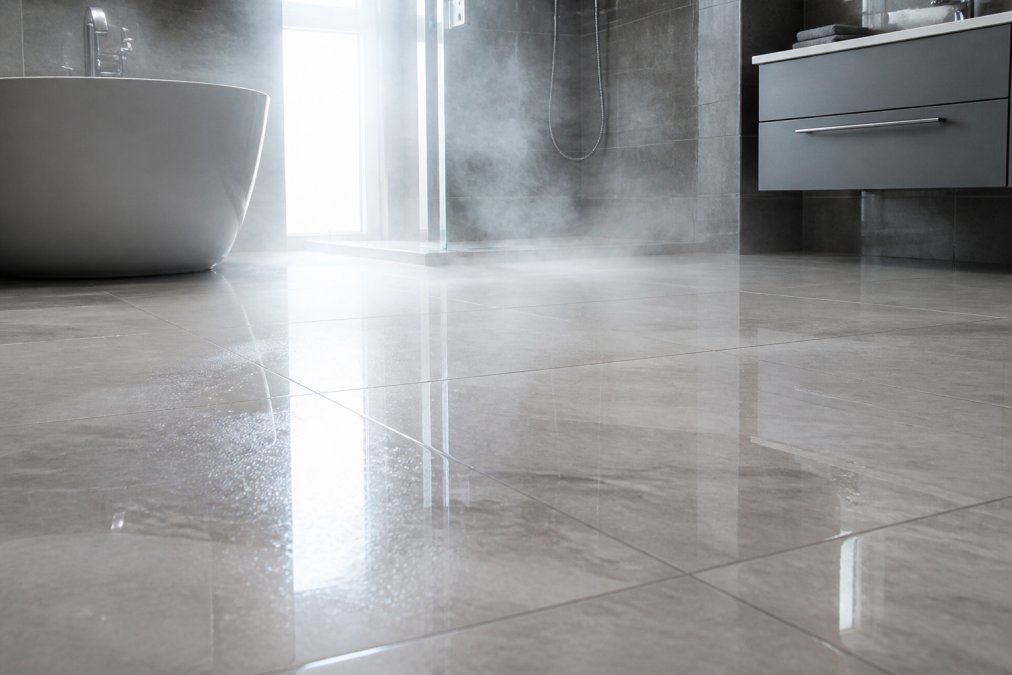
What makes porcelain the right choice for serious bathroom renovations: it handles humidity swings without expanding or contracting. Large-format slabs (12x24 inches or larger) reduce grout lines, which means fewer joints where water can penetrate. Fewer grout lines also mean less maintenance in humid conditions.
The honest limitation: porcelain feels cold underfoot without radiant heating. Installation requires skilled labor because the material is dense and harder to cut than ceramic. This translates to higher labor costs compared to other options.
Pros:
- Essentially permanent lifespan (30+ years with proper sealing)
- Cool underfoot in hot weather
- Available in textures that provide slip resistance (DCOF ratings above 0.60)
Cons:
- Cold surface without radiant floor heating
- Labor-intensive installation
- Higher upfront material cost
Best for: Primary bathrooms, master baths, and any high-moisture area where durability justifies the investment.
2. Luxury Vinyl Plank (LVP) vs Ceramic Tile for Bathrooms
The choice between LVP and ceramic tile often comes down to comfort versus cost. Luxury vinyl plank offers 100% waterproof performance with a softer, warmer feel underfoot than tile. Its multi-layer construction includes a wear layer that resists scratches and stains, plus a rigid core that prevents warping in humid conditions.
Installation differs dramatically: LVP uses a click-lock system that allows DIY installation or faster professional work. Ceramic tile requires mortar, grout, and skilled placement.
The critical difference for bathroom flooring humid environments: LVP's rigid core construction maintains dimensional stability even when humidity fluctuates. Ceramic tile, by contrast, remains porous unless sealed, and grout is vulnerable to water penetration in high-humidity environments.
LVP Pros:
- Completely waterproof core
- Easier and faster installation
- Warmer, more comfortable underfoot
- Lower labor costs
LVP Cons:
- Can expand if not installed with proper expansion gaps
- Lower resale value compared to tile
- Susceptible to extreme heat if subfloor is not properly prepared
Ceramic Tile Pros:
- Wide variety of colors and patterns
- Easier to cut and customize
- Highly customizable aesthetic
- Excellent value for budget remodels
Ceramic Tile Cons:
- More porous than porcelain (3-10% water absorption)
- Grout requires ongoing sealing in humid climates
- Can crack under heavy impact
- Higher labor costs due to mortar and grout work
Best for LVP: Renovations where comfort and ease of installation are priorities, or when budget constraints are tight but waterproofing is essential.
Best for Ceramic: Budget-conscious bathroom remodels where aesthetics matter and you're committed to regular grout maintenance.
3. SPC Vinyl Flooring: Stability in Temperature Swings
Stone Plastic Composite (SPC) flooring represents an evolution beyond standard luxury vinyl. Its core contains limestone and stabilizers, making it significantly denser and more rigid than LVP. This matters in humid climates where temperature fluctuations cause expansion and contraction.
SPC's superior density prevents the buckling and cupping that can occur with standard vinyl in high-humidity bathrooms. The attached underlayment options provide sound dampening and additional moisture protection. The material is 100% waterproof, making it ideal for bathrooms where moisture exposure is constant.
The trade-off: SPC feels harder and less comfortable underfoot than LVP. It also requires a very flat subfloor, any inconsistencies become noticeable underfoot and can cause premature wear. Installation must account for proper expansion gaps, typically 1/4 inch around all perimeter walls.
Pros:
- Highly stable in humid conditions with significant temperature swings
- Very durable against dents and heavy use
- Attached underlayment reduces sound
- 100% waterproof core
Cons:
- Less comfortable underfoot than LVP
- Requires a very flat subfloor (within 3/16 inch over 10 feet)
- Can be noisy without quality underlayment
- Requires precise installation for expansion gaps
Best for: Bathrooms in homes with significant seasonal temperature fluctuations or where maximum dimensional stability is required.
4. Ceramic Tile: Budget-Friendly Waterproof Bathroom Flooring Options
Ceramic tile offers a budget-friendly entry point into waterproof bathroom flooring. Made from clay and kiln-fired at lower temperatures than porcelain, ceramic remains porous but can be sealed to resist moisture penetration. Its water absorption rate ranges from 3-10%, which sounds problematic, but proper sealing and grout maintenance make it viable for humid bathrooms.
The key to ceramic success in humid climates: professional-grade grout sealants applied after installation and reapplied every 1-2 years. This ongoing maintenance commitment is non-negotiable.
Pros:
- Excellent value for the price (lowest material cost)
- Highly customizable aesthetic
- Naturally resistant to mold and mildew when sealed
- Compatible with professional-grade sealants
Cons:
- More porous than porcelain (requires ongoing maintenance)
- Can crack under heavy impact or thermal stress
- Grout requires periodic resealing (every 1-2 years)
- Higher labor costs than vinyl options
5. Sealed Concrete: Modern Industrial Durability
Sealed concrete has emerged as a trendy, practical option for modern and industrial-style bathrooms. When properly sealed with moisture-blocking sealants, concrete becomes impervious to water damage. The seamless surface prevents water seepage at joints, a major vulnerability in tiled bathrooms.
Pros:
- Impervious to water damage when properly sealed
- Very low maintenance once sealed
- Seamless surface prevents water seepage
- Customizable through staining and polishing
Cons:
- Requires professional sealing to prevent staining
- Very hard and cold surface without radiant heating
- Requires skilled installation for proper finish
- Can be slippery when wet (requires textured finish)
Bathroom Flooring Installation Cost and Subfloor Preparation
Installation considerations vary dramatically based on material selection and subfloor conditions. Before any flooring goes down, the subfloor must be properly prepared, this is where many bathroom renovation projects face challenges.
The installation process itself varies by material:
- Porcelain tile: Requires mortar application, proper spacing, and grout work. Skilled labor is essential. Expect longer timelines (5-7 days for a standard bathroom).
- Luxury vinyl plank: Click-lock installation moves faster. Can be completed in 2-3 days for a standard bathroom.
- SPC vinyl: Similar timeline to LVP, but requires more precision for subfloor flatness verification.
- Ceramic tile: Comparable to porcelain in timeline and labor intensity.
- Sealed concrete: Requires curing time between sealant coats. Total project timeline extends 7-10 days.
Frequently Asked Questions
What is the most durable flooring for a bathroom in a humid climate?
Porcelain tile offers the longest lifespan and superior moisture resistance with water absorption rates below 0.5%. It resists mold, mildew, and humidity-induced expansion. SPC vinyl runs a close second for stability in temperature fluctuations. Both maintain performance for 20+ years with proper maintenance and sealing of grout lines.
Is LVP vs ceramic tile better for bathrooms?
LVP excels in comfort, ease of installation, and cost-effectiveness, making it ideal for quick renovations. Ceramic tile offers superior durability and resale value at a lower material cost than porcelain, though it's more porous and requires professional sealing. Choose LVP for comfort and convenience; choose ceramic or porcelain for long-term durability and home value.
What waterproof bathroom flooring options work best on slab foundations?
Porcelain tile, SPC vinyl, and sealed concrete all perform well on slabs because they don't require extensive underlayment. Ensure your slab has a proper vapor barrier installed before flooring. LVP and ceramic tile also work on slabs but need careful subfloor preparation to prevent moisture migration and expansion issues in humid conditions.
How much does bathroom flooring installation cost, and what affects the price?
Material costs vary depending on type. Installation labor, subfloor preparation, and vapor barrier work can impact the overall investment. Slab foundations may require additional moisture mitigation. Contact Handy Gonzo's Home Improvements for a transparent digital quote that breaks down materials, labor, and timeline for your specific project.
Does high humidity really damage bathroom flooring?
Yes. Humidity causes wood-based materials to swell and contract, leading to warping and gaps. Unsealed grout absorbs moisture, promoting mold growth. Porous tiles absorb water, reducing lifespan. Materials with low water absorption rates (porcelain, SPC vinyl, sealed concrete) and properly sealed grout resist humidity damage far better than standard ceramic or engineered hardwood.