 listicle
Best Materials for Luxury Custom Home Builds
Table of Contents
- Why Material Selection Matters in a Custom Luxury Home
- High-End Home Building Materials That Define Premium Spaces
- Best Flooring for Luxury Homes: Durability Meets Aesthetics
- Energy-Efficient Windows for Custom Homes and Glass Walls
- Exterior Materials: Siding, Roofing, and Weather Protection
- Luxury Home Material Selection Checklist: Climate, Cost, and Compatibility
- Material Comparisons by Application: What Works Where
- Sustainable and Locally Sourced Options for Custom Builds
- Frequently Asked Questions
Last Updated: October 18, 2026
Why Material Selection Matters in a Custom Luxury Home
Choosing the best materials for luxury custom home builds sets the foundation for how your home looks, performs, lasts, and retains value.
The difference between a home that impresses for five years and one that commands respect for fifty comes down to durability, energy efficiency, and structural integrity, not just aesthetics.
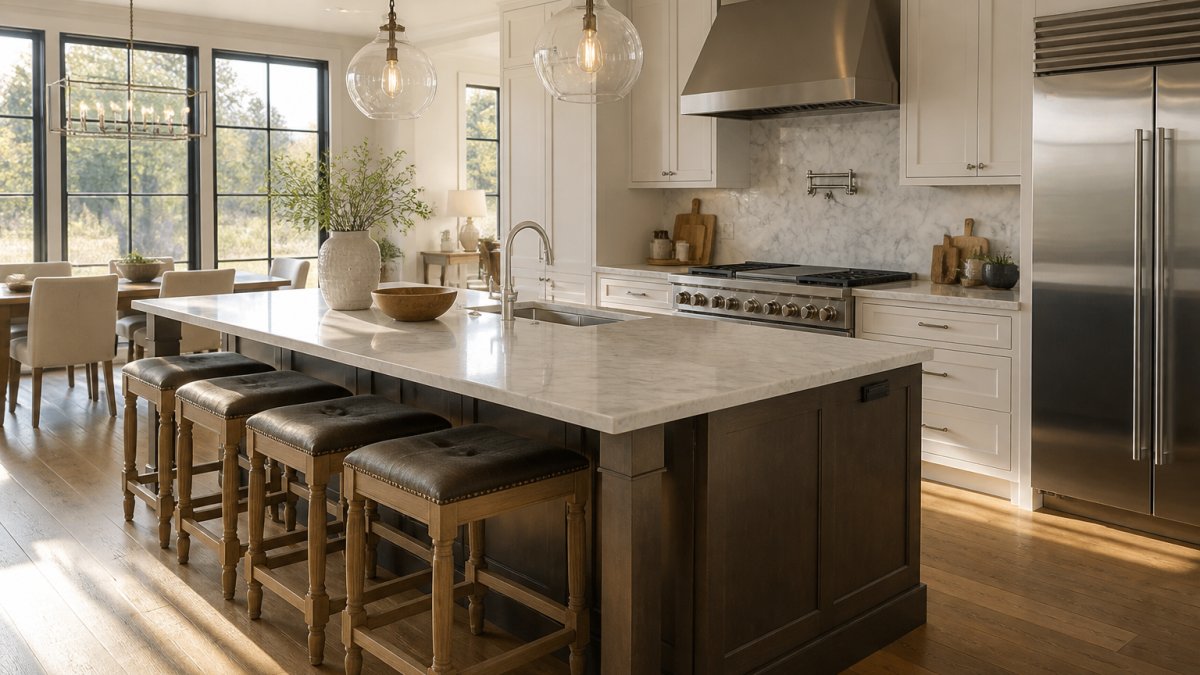
High-End Home Building Materials That Define Premium Spaces
The best materials for luxury custom home builds fall into distinct categories, each serving a specific purpose.
Natural Stone for Countertops, Walls, and Architectural Features
Natural stone remains the gold standard for luxury homes, combining visual impact with durability. Marble offers timeless elegance but needs more maintenance; granite is harder and more forgiving for high-traffic areas; onyx creates dramatic translucent focal points; travertine delivers warmth suited to Mediterranean or contemporary designs.
The key consideration is application: kitchen countertops demand different properties than bathroom walls or architectural accents. Locally sourced stone reduces transportation costs and environmental impact.
Premium Wood and Wide-Plank Hardwood Flooring
Wide-plank hardwood flooring defines luxury interiors: the wider the plank, the more dramatic the impact and the fewer seams interrupt sightlines. Top-grade lumber, quarter-sawn oak, walnut, or reclaimed wood, creates warmth engineered alternatives struggle to match.
Premium hardwood differs from standard in grain consistency, color uniformity, and milling care. Installation matters just as much: proper acclimation, expert installation, and appropriate underlayment ensure decades of performance.
Metal Accents and Structural Steel Details
Steel and metal accents add architectural interest and structural capability. Exposed beams, metal railings, and steel-frame systems are design statements: stainless steel resists corrosion, powder-coated steel offers color and durability, and brass and copper develop patina.
Metal integration requires thoughtful design, a steel beam spanning an open-concept living area becomes a visual anchor, and railings on a floating staircase create drama while maintaining sightlines.
Best Flooring for Luxury Homes: Durability Meets Aesthetics
Flooring is one of your most visible material choices and hardest to change later. The best flooring for luxury homes balances visual appeal with practical performance: wide-plank hardwood dominates, but polished concrete, natural stone, and high-end tile each have their place.
Durability matters more in luxury homes because you're investing significantly and expecting decades of performance. Factor hardness ratings, moisture resistance, and maintenance into your decision; a beautiful material that fails in your climate is a poor investment.
Consider how materials perform by zone: the entry demands more durability than a formal living room, and kitchen flooring must handle moisture and spills differently than a bedroom.
Energy-Efficient Windows for Custom Homes and Glass Walls
Windows and glass form the boundary between your controlled interior and the outside environment.
High-performance windows feature multiple panes, low-emissivity coatings, and insulated frames that minimize heat transfer. Triple-pane windows offer superior insulation in cold climates, and fiberglass and vinyl frames outperform aluminum thermally.
Glass walls blur the line between indoors and outdoors, flooding spaces with natural light.
Exterior Materials: Siding, Roofing, and Weather Protection
Your home's exterior must protect the structure while defining its visual character.
Roofing must protect against weather while contributing to aesthetics. Metal roofing offers longevity and energy efficiency; architectural asphalt shingles provide traditional looks at lower cost; slate and tile deliver premium appearance and exceptional longevity.
The building envelope, siding, roofing, insulation, and moisture barriers together, determines how well your home performs. Poor selection or installation here leads to moisture problems, energy loss, and structural issues.
Luxury Home Material Selection Checklist: Climate, Cost, and Compatibility
A luxury build fails on materials for predictable reasons: climate wasn't matched, budget was allocated by room instead of service life, or two materials fight each other in the assembly. The framework below is the sequence experienced builders use to lock a specification before construction documents are finalized.
Step 1: Map the site's climate and hazard profile
Before you look at a single sample, document the conditions the home will face.
| Condition | What it stresses | Practical recommendations |
|---|---|---|
| High humidity / frequent rain | Wood movement, mold, corrosion, mortar failure | Engineered hardwood over solid in wet zones; back-ventilated rain-screen cladding; stainless or hot-dip galvanized fasteners; whole-home dehumidification |
| Coastal salt air | Metal corrosion, fastener failure, paint adhesion | Marine-grade stainless or high-performance coatings on metal; fiber cement or brick over cedar; corrosion-resistant window hardware |
| Freeze-thaw cycles | Stone spalling, concrete cracking, masonry movement | Air-entrained concrete; frost-resistant stone and tile; proper slope and drainage; expansion joints in masonry |
| Wildfire exposure | Ember intrusion, radiant heat, combustible cladding | Class A roofing; noncombustible siding (fiber cement, brick, stucco); ember-resistant vents; tempered multi-pane glazing |
| High wind / hurricane | Uplift, impact, water intrusion | Impact-rated glazing and doors; continuous load path; tested cladding and roofing assemblies |
| Intense sun / UV | Fading, thermal expansion, sealant degradation | UV-stable finishes; low-E or spectrally selective glazing; lighter-colored roofing in hot climates |
| Expansive clay soils | Foundation movement, cracking | Post-tensioned or pier-and-beam foundation design; flexible finishes at movement joints |
Step 2: Set the budget by service life, not by room
Luxury budgets are finite even when large. The most common allocation error is spending by visibility instead of replacement difficulty:
- Hardest to replace (allocate first): foundation, structural framing, roofing, windows, exterior cladding, and the building envelope. These carry the highest tear-out cost and the longest service life.
- Moderate replacement difficulty: flooring, cabinetry, countertops. Plan for one refresh cycle over a 30-year horizon.
- Easiest to replace: fixtures, hardware, paint, and decorative finishes. These can be upgraded later without disturbing the assembly.
Experienced owners often specify premium envelope materials and mid-tier decorative finishes, then upgrade finishes later. The reverse, premium finishes over a compromised envelope, is the most expensive mistake in the category.
Step 3: Verify material compatibility in the assembly
Every material touches something else. Before finalizing, confirm these interfaces in writing:
- Cladding to sheathing: Is there a drainage plane and air gap? Are fasteners compatible with the cladding's galvanic profile?
- Windows to wall: Is there a continuous air and water seal, and does the flashing sequence shed water outward at every layer?
- Wood flooring to substrate: Is there a vapor barrier appropriate to slab-on-grade, and is the acclimation schedule written into the contract?
Step 4: Request samples and lead-time commitments
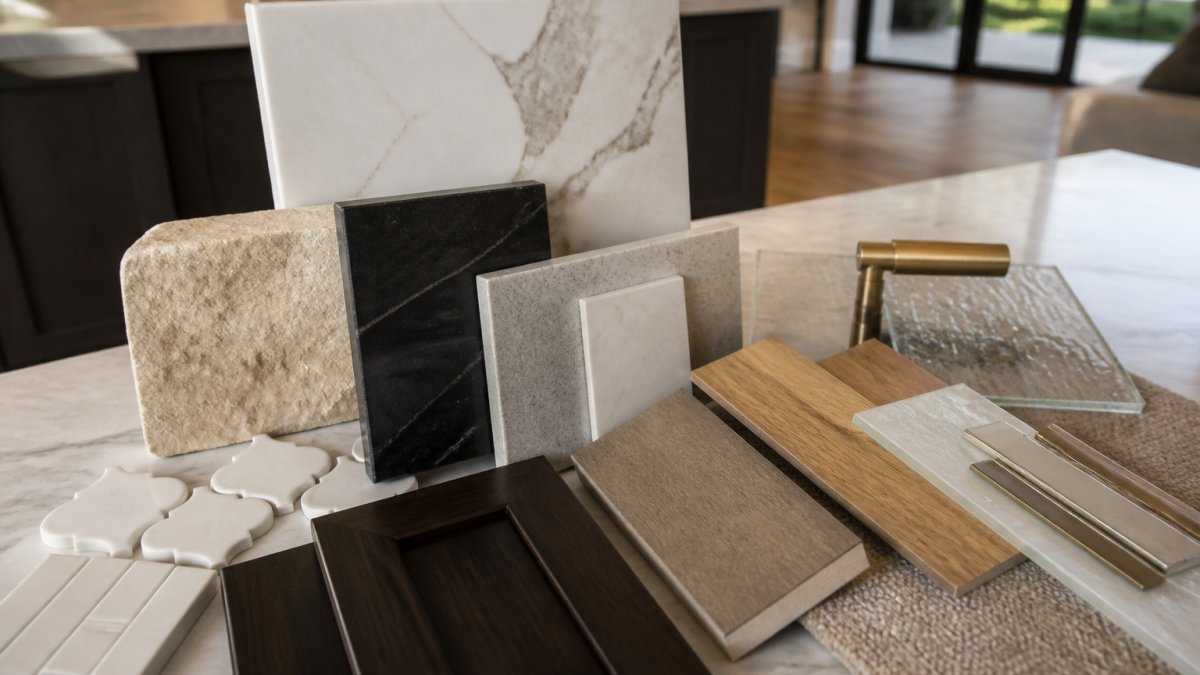
Samples are not a formality. Request full-size samples in the actual lighting of the room, and view stone slabs in person, not from a photo. Confirm:
- Lead times for each premium material, in writing, with a contingency plan for backorders.
- Lot and dye-lot matching for tile, stone, and wood so future repairs match.
- Attic stock, order 5-10% extra of tile, flooring, and stone for future repairs.
Step 5: Coordinate with the builder before specifications are frozen
Material decisions made after framing begins drive change orders. Finalize envelope and structural materials first, then interior finishes, then decorative selections, each with a signed-off specification sheet. Keep a decision log recording what was chosen, why, and who approved it.
Material Comparisons by Application: What Works Where
Most guides tell you marble is elegant and granite is durable, that's not a decision framework. What separates premium materials is how they perform in a specific application over a specific service life, and what they cost to own, not just install. The comparison below is organized by application.
How to read the comparison
Four variables drive most material decisions in a luxury build:
- Installed cost range, material plus fabrication, substrate prep, and labor. Ranges below are typical national mid-to-high-end residential figures and vary by region, edge profile, slab size, and site access.
- Lifecycle cost, expected service life plus recurring maintenance (sealing, refinishing, recoating) and the replacement interval you should budget for.
- Performance under stress, heat, moisture, freeze-thaw, salt, UV, and impact.
Kitchen and bath countertops
| Material | Typical installed cost (USD/sq ft) | Expected service life | Maintenance cadence | Best use | Watch-outs |
|---|---|---|---|---|---|
| Natural marble | $75-$150+ | 20-50 years with care | Seal every 6-12 months; etch repair as needed | Statement islands, low-use baths | Etches from acids (citrus, wine, vinegar); stains if unsealed |
| Granite | $60-$120 | 30+ years | Seal every 12-24 months | High-traffic kitchens | Shade variation between slabs; some varieties porous |
| Quartz (engineered) | $60-$120 | 15-25 years | Wipe-clean; no sealing | Busy kitchens, rental-grade durability | Heat-sensitive, use trivets; seams visible on large runs |
| Soapstone | $70-$120 | 30+ years | Oil monthly to build patina | Farmhouse and transitional kitchens | Soft, scratches and dings; patina is intentional |
| Porcelain slab | $50-$100 | 25+ years | Minimal | Full-height backsplashes, wet zones | Fabrication skill critical; edge chipping risk |
A common pattern: homeowners who entertain heavily choose granite or quartz for the working kitchen and reserve marble for a butler's pantry or primary bath vanity where acid exposure is lower.
Flooring by zone
| Material | Installed cost (USD/sq ft) | Service life | Moisture behavior | Best zones |
|---|---|---|---|---|
| Solid wide-plank hardwood | $12-$30 | 50+ years (refinishable 3-5x) | Moves with humidity; not for slab-on-grade or baths | Living, dining, bedrooms in stable-humidity homes |
| Engineered hardwood | $9-$22 | 25-40 years (refinishable 1-2x) | Dimensionally stable; suitable over slab with proper barrier | Whole-home, including basements with vapor control |
| Natural stone tile | $15-$40 | 50+ years | Excellent when sealed and on proper substrate | Foyers, baths, mudrooms |
| Porcelain tile (large-format) | $10-$30 | 30+ years | Impervious | Kitchens, baths, laundry |
| Polished concrete | $8-$20 | 30+ years | Good with sealer; hairline cracks possible | Modern great rooms, basements |
Exterior cladding and roofing
| Material | Installed cost (USD/sq ft) | Service life | Climate fit | Maintenance |
|---|---|---|---|---|
| Fiber cement siding | $8-$16 | 30-50 years | Broad; good in humid and coastal with proper clearances | Repaint every 10-15 years |
| Cedar siding | $10-$20 | 20-40 years | Best in dry/moderate climates; needs back-ventilation in wet climates | Stain or oil every 3-5 years |
| Brick veneer | $15-$30 | 75+ years | Excellent in all climates; requires weep system | Minimal |
| Manufactured stone veneer | $12-$25 | 30-50 years | Good; flashing details critical | Minimal |
| Standing-seam metal roof | $12-$25 | 40-70 years | Excellent; snow-shedding in cold, reflective in hot | Minimal; inspect fasteners |
| Architectural asphalt shingles | $5-$12 | 20-30 years | Broad | Minimal; replace at end of life |
| Natural slate | $25-$60+ | 75-100+ years | Cold and temperate; heavy, verify framing capacity | Minimal |
Windows and glazing
| Specification | Installed cost (USD per unit, typical) | Performance note | Best use |
|---|---|---|---|
| Double-pane, low-E, vinyl frame | $600-$1,200 | Good U-factor; frame thermally weaker than fiberglass | Budget-conscious whole-home |
| Double-pane, low-E, fiberglass frame | $900-$1,800 | Better thermal performance and stability | Most climates |
| Triple-pane, fiberglass or wood-clad | $1,500-$3,500+ | Superior insulation; heavier; confirm structural and hardware capacity | Cold climates, noise-sensitive sites |
| Large-format sliding/folding glass walls | $1,000-$3,000+ per linear foot | Structural headers and drainage details drive cost | Indoor-outdoor great rooms |
The compatibility variable most guides skip
Material performance is rarely about the material alone, it's about the assembly. A few rules experienced builders apply:
- Wood and moisture: Solid wood flooring needs interior relative humidity held roughly in the 35-55% band. In humid climates, that means a whole-home dehumidification strategy, not just an HVAC system sized for temperature.
- Stone and mortar: Natural stone veneer needs a drainage plane and weep system behind it. Mortar-direct-to-sheathing installations trap water and are a leading cause of premature failure.
- Metal and wood: Dissimilar materials expand at different rates. Steel beams passing through exterior walls need thermal breaks to prevent condensation and energy loss.
Sustainable and Locally Sourced Options for Custom Builds
Sustainable material choices increasingly define luxury homes.
Energy-efficient materials reduce operating costs and environmental footprint: high-performance windows, superior insulation, and reflective roofing lower heating and cooling demands.
Handy Gonzo's Home Improvements can help you navigate sustainable choices without compromising luxury or performance. Our experience has taught us which materials deliver both environmental responsibility and lasting value.
| Material Type | Best Applications | Durability | Maintenance | Climate Suitability |
|---|---|---|---|---|
| Natural Stone | Counters, walls, accents | Excellent | Moderate to High | Variable by type |
| Wide-Plank Hardwood | Flooring, architectural | Very Good | Moderate | Dry to moderate humidity |
| Engineered Hardwood | Flooring | Very Good | Low | All climates |
| Fiber Cement Siding | Exterior cladding | Excellent | Low | All climates |
| Metal Roofing | Roofing systems | Excellent | Low | All climates |
| Triple-Pane Windows | Exterior glazing | Very Good | Low | Cold climates |
| Quartz Surfaces | Counters, vanities | Excellent | Low | All applications |
Building a luxury custom home demands material decisions that balance aesthetics, performance, and longevity.
Frequently Asked Questions
What materials make a custom home feel luxurious?
Natural stone, wide-plank hardwood, high-performance glass, and metal architectural details create a sense of quality and refinement. Luxury comes from material authenticity, finish quality, and how materials work together. Stone countertops paired with premium cabinetry, energy-efficient windows that frame views, and durable flooring that shows grain and character all signal investment and permanence. Consistency across materials, avoiding mismatched finishes, reinforces the luxury aesthetic.
Which luxury home materials are the most durable?
Natural stone, engineered hardwood, and high-grade steel outlast most alternatives by decades. Marble and granite resist scratching and staining when sealed; wide-plank hardwood withstands foot traffic and can be refinished multiple times. Fiber cement siding resists rot and weather damage far better than standard materials. Metal accents don't corrode if properly finished. Durability depends on installation quality and maintenance, even premium materials fail if installed incorrectly or exposed to unsuitable conditions.
How do you choose building materials for a luxury home based on climate?
Match materials to local temperature swings, humidity, UV exposure, and weather hazards. In hot, dry climates, light-colored stone and reflective roofing reduce heat absorption. In humid regions, engineered hardwood resists warping better than solid wood; metal must be corrosion-resistant. In storm-prone areas, impact-rated windows and reinforced roofing systems protect the building envelope. Locally sourced stone and materials adapted to regional conditions also reduce transportation costs and environmental impact while performing better in their native climate.
Are natural stone countertops worth the cost in a custom home?
Natural stone adds lasting value, visual impact, and durability that justify the investment in high-end builds. Marble, granite, and onyx resist heat, scratching, and staining when sealed and maintained. They're repairable, chips can be filled, surfaces can be refinished, extending their lifespan indefinitely. Stone also increases home value and appeal to future buyers. Cost depends on thickness, finish, and installation complexity; pricing varies widely based on material sourcing and labor, so get a detailed quote from your contractor.