 ultimate-guide
Eco Friendly Kitchen Renovation Materials: 2026 Guide
Table of Contents
- Why Eco Friendly Kitchen Renovation Materials Matter in 2026
- Low-VOC Kitchen Cabinets: What to Look For
- Sustainable Countertop Materials That Hold Up
- Eco-Friendly Kitchen Design Trends Shaping Remodels
- Renewable Flooring and Reclaimed Wood Options
- Lifecycle Assessment and Budget Trade-Offs
- Maintenance, Longevity, and Disposing of Old Materials
- Conclusion
- Frequently Asked Questions
Last Updated: September 29, 2026
Why Eco Friendly Kitchen Renovation Materials Matter in 2026
Indoor air quality is where eco friendly kitchen renovation materials earn their keep first. Cabinets, counters, adhesives, and finishes off-gas volatile organic compounds for months after installation, and the kitchen is the room where your family spends the most waking hours. Indoor air quality is where eco friendly kitchen renovation materials earn their keep first. Cabinets, counters, adhesives, and finishes off-gas volatile organic compounds for months after installation, and the kitchen is the room where your family spends the most waking hours.
The EPA's indoor air quality guidance treats indoor pollutant levels as a genuine health concern, not a marketing angle.
Low-VOC Kitchen Cabinets: What to Look For
Low-VOC kitchen cabinets are boxes and doors built with formaldehyde-free substrates, water-based finishes, and adhesives that don't off-gas. Ask for the composite wood panel spec before you talk door style. That single document tells you more than any showroom finish will.
FSC-Certified and Formaldehyde-Free Cabinet Options
FSC-certified means the wood fiber traces back to responsibly managed forests. Formaldehyde-free means the binder in the plywood or MDF contains no added urea-formaldehyde. You want both, and you want them in writing.
- FSC-certified plywood boxes with NAUF (no added urea-formaldehyde) cores
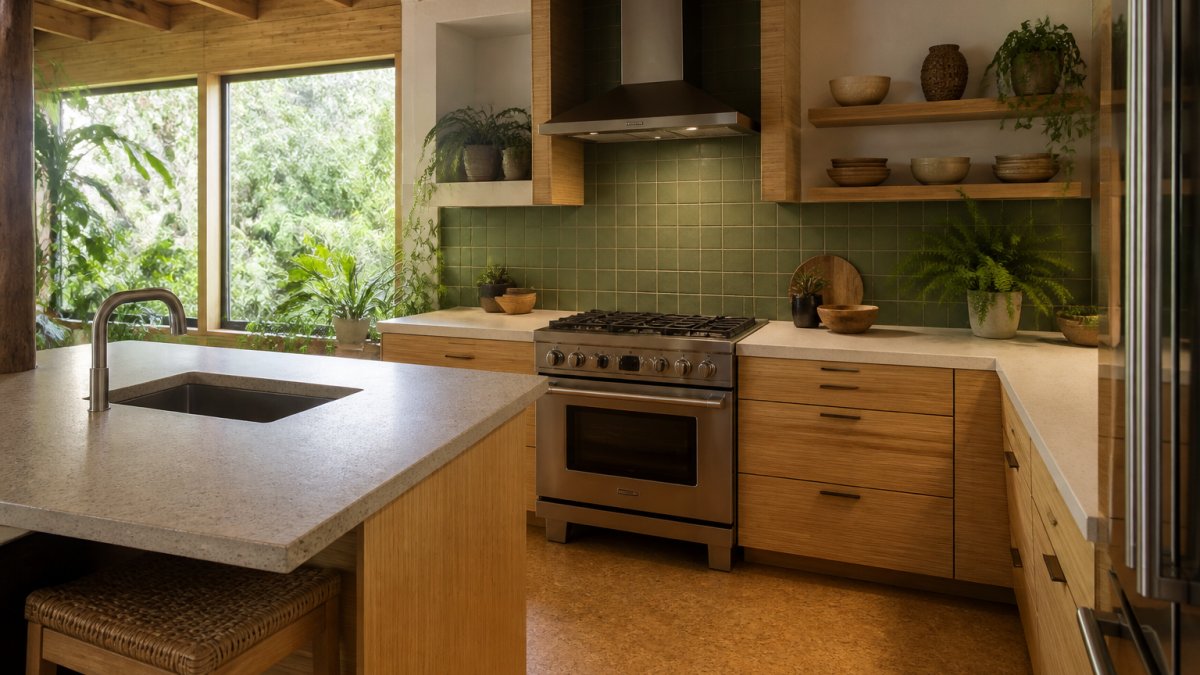
- Solid wood or bamboo faces finished with water-based lacquer
- Powder-coated or stainless steel frames for a zero-off-gas box
- Reclaimed wood fronts where character matters more than uniformity
Sustainable Countertop Materials That Hold Up
Sustainable countertop materials are surfaces made from recycled, rapidly renewable, or low-energy inputs that still take daily abuse. The catch: "eco" doesn't mean indestructible. Each option has a real weak point, and knowing it prevents a callback.
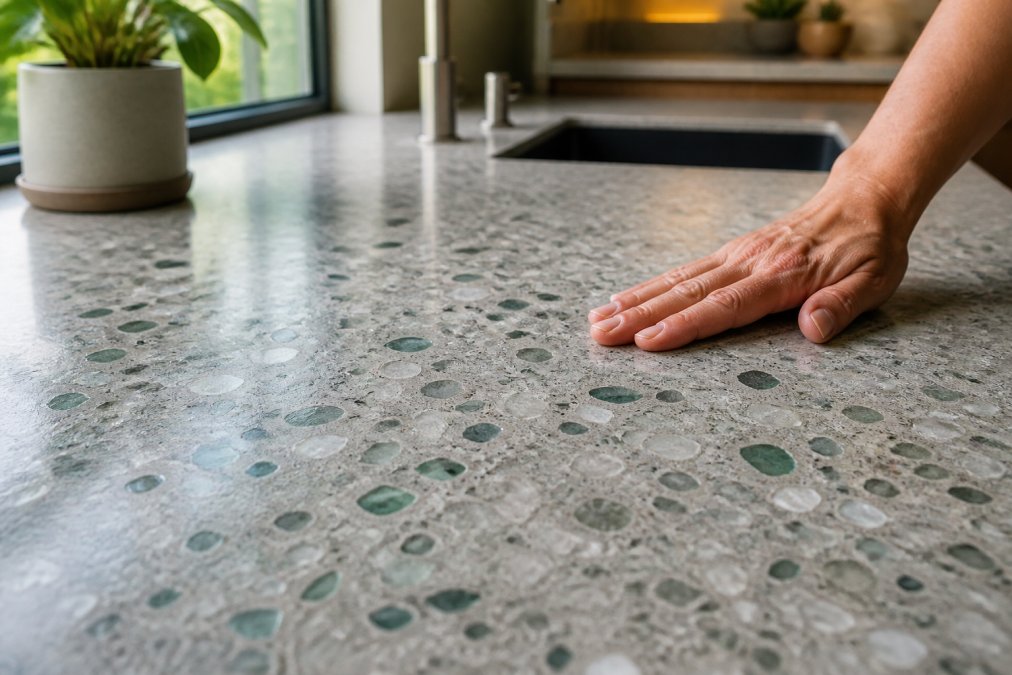
Recycled Glass, Paperstone, and Richlite Compared
| Material | Best For | Watch Out For |
|---|---|---|
| Recycled glass | Color-forward kitchens, heat resistance | Can chip at edges; needs a pro fabricator |
| Paperstone | Warm matte look, easy patching | Scratches show; avoid knife work directly on it |
| Richlite | Modern slab look, seamless runs | Darkens over time; needs periodic oiling |
Recycled glass counters fuse post-consumer glass into a slab, which diverts material from landfill and gives you a surface that shrugs off heat. Paperstone and Richlite are paper-composite surfaces made from recycled content and phenolic resin, and both are workable with standard woodworking tools.
Eco-Friendly Kitchen Design Trends Shaping Remodels
The most useful trend in 2026 isn't a finish or a color, it's that homeowners are starting to ask for a lifecycle assessment before they sign a materials list. A lifecycle assessment (LCA) evaluates a product's environmental impact from raw material extraction through manufacturing, shipping, installation, use, and end-of-life disposal. Almost no showroom will volunteer this. It's the single lens that separates a genuinely green kitchen from a green-labeled one.
Three trends worth following, reframed through an LCA lens:
- Fewer materials, better ones. One FSC-certified wood species used consistently across cabinets, shelving, and trim beats four trendy finishes that each need replacing in a decade. Fewer material types also means fewer adhesives, fewer finishes, and a simpler end-of-life sort when the kitchen is eventually updated.
- Repairable surfaces over replaceable ones. Solid wood, cork, and linoleum can be sanded or patched in place. Engineered laminates and many composite slabs usually can't. Repairability is the cheapest form of carbon reduction because it avoids manufacturing an entirely new surface.
- Circular sourcing as a design feature. Reclaimed and upcycled materials are no longer a compromise, they're a specification. Salvaged beams, vintage hardware, and surplus tile from a local reclamation yard all carry near-zero manufacturing impact.
Budget vs. Sustainability: Where to Spend and Where to Save
- Cabinets and adhesives first. These are your biggest indoor air quality lever and the hardest item to upgrade later. A formaldehyde-heavy box is a permanent problem; drawer pulls are not.
- Countertops second. Choose repairable over trendy. A surface you can re-oil or patch beats one you'll replace in eight years.
- Flooring third. Spend where daily wear is highest, entry paths and the work zone in front of the sink and range.
- Fixtures last. Energy Star and WaterSense-rated models pay back over time, and they're the easiest category to swap on a future weekend.
If you're coming from an all-quartz, all-vinyl mindset, expect the eco route to feel warmer and slightly less uniform. That's the trade, and it's usually the one homeowners say they'd make again.
Renewable Flooring and Reclaimed Wood Options
Renewable flooring means material that regrows quickly or comes from existing structures rather than new harvest. Bamboo, cork, and linoleum lead the category, and reclaimed wood sits alongside them as the ultimate upcycled option.
- Bamboo: A renewable resource that matures fast; strand-woven planks handle kitchen traffic well.
- Cork: Soft underfoot, naturally insulating, and comfortable for long standing sessions at the counter.
- Marmoleum: A linseed-oil-based sheet flooring that's biodegradable and remarkably tough.
- Reclaimed wood: Salvaged beams and barn boards with character no new lumber can match.
Lifecycle Assessment and Budget Trade-Offs
Lifecycle assessment is the practice of evaluating a material's environmental impact from extraction through disposal, not just at the point of purchase. It's the single most useful lens for a renovation budget.
Where budgets get tight, prioritize in this order:
- Cabinets and adhesives. These are your biggest indoor air quality lever.
- Countertops. Choose repairable over trendy.
- Flooring. Spend where daily wear is highest.
- Fixtures. Energy Star and WaterSense-rated models pay back over time.
Maintenance, Longevity, and Disposing of Old Materials
Maintenance and disposal are where eco renovations either hold their value or quietly undo it. A green kitchen that gets ripped out in six years wasn't green, longevity is the whole point, and the disposal of what you remove is the part almost every guide skips.
Maintenance Schedules That Actually Extend Life
Eco-friendly materials often need specific care. Follow the schedule and they outlast their conventional counterparts; skip it and you'll be replacing them early, which defeats the purpose.
- Paper-composite counters (Paperstone, Richlite): Re-oil annually with a food-safe mineral or tung oil. Wipe acidic spills, citrus, vinegar, wine, promptly, because the phenolic resin can dull if left wet. Never place a hot pan directly on the surface; use a trivet.
- Cork and linoleum (Marmoleum) floors: Damp-mop with a pH-neutral cleaner, never a steam mop or standing water. Reseal every few years with the manufacturer's recommended finish. Felt pads under chairs prevent the scuffing that leads to premature replacement.
- Water-based cabinet finishes: Clean with mild soap and a soft cloth. Abrasive pads and ammonia-based cleaners break down the film and force a recoat years earlier than necessary.
- Reclaimed wood: Control indoor humidity, typically 30-50% relative humidity, to prevent seasonal movement, cupping, and gaping. A whole-home humidifier or dehumidifier is often cheaper than a floor repair.
- Bamboo and strand-woven planks: Keep the surface dry and use area rugs at the sink and range. Bamboo is sensitive to prolonged moisture at the seams.
Disposing of Old Materials Responsibly
- Donate usable cabinets and appliances. Local Habitat for Humanity ReStores and similar reuse organizations accept working cabinets, appliances, and hardware. Many will pick up.
- Recycle metal appliances. Refrigerators, ranges, and dishwashers contain steel, copper, and aluminum that scrap and appliance recyclers pay for or accept free. Ask whether they handle refrigerant recovery, federal rules require it for refrigerators and freezers.
- Check your municipality's construction and demolition (C&D) debris program. Many cities run separate C&D drop-off sites or curbside bulky-item pickup that diverts material from the general waste stream.
- Reuse old countertops. A granite or quartz remnant makes an excellent garage workbench, laundry folding surface, or workshop top.
- Keep old fixtures out of the landfill. Faucets, sinks, and lighting often have a recycling stream through metal recyclers or reuse stores.
- Separate salvageable lumber and trim. Reclaimed dimensional lumber, solid-wood doors, and trim can be resold or reused on the same project.
Waste diversion is the least glamorous part of an eco-friendly renovation, and it's often where the biggest environmental gains hide. Old cabinets in a landfill undo a lot of good sourcing upstairs.
The most sustainable kitchen is the one you don't replace twice. Specify for longevity first, maintain what you install, and divert what you remove.
Conclusion
The hard part of an eco-friendly kitchen isn't finding green products. It's specifying them correctly, installing them so they last, and disposing of the old materials without sending everything to the landfill. That takes experience across trades, and it takes a crew that stays on the job from demolition to final coat.
Frequently Asked Questions
What are some eco friendly kitchen materials?
Eco friendly kitchen renovation materials include FSC-certified or formaldehyde-free cabinets, recycled glass and Paperstone countertops, bamboo or cork flooring, and low-VOC paints and finishes. Reclaimed wood and Marmoleum are also strong choices. Look for third-party certifications and check indoor air quality ratings before you buy.
How can I ensure my kitchen renovation materials are non-toxic?
Ask for low-VOC or zero-VOC finishes, formaldehyde-free cabinet boxes, and non-toxic adhesives and sealants. Check labels for GREENGUARD Gold or similar certifications. Avoid composite wood with urea-formaldehyde binders. Ventilate the space during and after installation, and confirm with your contractor that all caulks, glues, and paints meet indoor air quality standards.
Are bamboo cabinets a durable choice for kitchen remodels?
Bamboo cabinets are durable when the material is strand-woven or carbonized, which increases hardness. They resist moisture better than some softwoods and are a renewable resource since bamboo grows back quickly. The main drawback is that cheap bamboo can dent or scratch. Look for FSC-certified bamboo and confirm the manufacturer uses low-VOC adhesives.
What are the most sustainable flooring options for kitchens?
Bamboo, cork, and Marmoleum are among the most sustainable flooring options for kitchens. Cork and Marmoleum handle moisture well and are made from renewable or biodegradable materials. Reclaimed wood works if it is properly sealed. Avoid vinyl if you want a low carbon footprint, and ask about the adhesive since that often carries more VOCs than the flooring itself.